The Coronation of King Charles III and Queen Camilla was a splendid celebration

Photo: The Coronation of King Charles III and Queen Camilla 

Photo Credit: The Royal Family UK 🇬🇧


Photo: The Coronation of King Charles III and Queen Camilla
Photo Credit: The Royal Family UK 🇬🇧

Photo: The Coronation of King Queen Camilla 

Photo Credit: The Royal Family UK 🇬🇧

Photo: King Charles III
Photo Credit: The Royal Family UK 🇬🇧

6 May 2024

On this historic day, the Diplomatic Informer Magazine SA wishes to extend our heartfelt warm wishes to their Majesties, King Charles III and Queen Camilla and the people of the United Kingdom on their #Coronation

The Coronation of Their Majesties The King and The Queen took place today, Saturday, 6th May 2023, at Westminster Abbey on in the first Coronation Service in almost 70 years. Their Majesties arrived at Westminster Abbey in procession from Buckingham Palace, known as ‘The King’s Procession’.

After the Service, Their Majesties returned to Buckingham Palace in a larger ceremonial procession, known as ‘The Coronation Procession’. Their Majesties were joined in the procession by other Members of the Royal Family.

Upon returning, The King and The Queen received a Royal Salute in the Garden of Buckingham Palace from the Armed Forces, taking part in the Processions.

The King and The Queen, accompanied by Members of the Royal Family, then appeared on the Buckingham Palace Balcony for the Flypast and the conclusion of the day’s ceremonial events

For the last nine centuries, the coronation ceremony has taken place at Westminster Abbey as the Royal church for the Palace of Westminster

For almost a thousand years, Coronations have been held at Westminster Abbey, and the Order of Service draws on this long tradition, centred around the liturgical theme of “Called to Serve” and The King’s solemn vow and commitment to serve God, and the people of the nations and the realms.

The Service was conducted by the Archbishop of Canterbury, the Most Reverend and Right Honourable Justin Welby. The Choirs of Westminster Abbey and His Majesty’s Chapel Royal, St James’s Palace, with choristers from Methodist College, Belfast, and Truro Cathedral Choir, and an octet from the Monteverdi Choir, sang. The music during the service was directed by Andrew Nethsingha, Organist and Master of the Choristers, Westminster Abbey.

#Coronation
#coronationday2023
#Commonwealth
#KingCharlesIII

Africa’s Travel Indaba

5 May 2023

Africa’s Travel Indaba (ATI) will take place at the Durban International Convention Centre (ICC) in the Kwa-Zulu Natal Province from 08 to 11 May 2023. The trade show showcases the widest variety of Southern Africa’s best tourism products and services, and afford delegates an opportunity to acquaint themselves with the exciting travel experiences on offer – with a view of forging dynamic tourism partnerships.

The ATI is one of the largest tourism marketing events on the African calendar and one of the top three ‘must visit’ events of its kind on the global calendar. It has won the accolades as Africa’s best travel and tourism show awarded by the Association of World Travel Awards.

DEPARTMENT OF TOURISM EVENTS AT AFRICA’S TRAVEL INDABA

Africa’s Travel Indaba offers industry players and its stakeholders an opportunity to meet and engage on the challenges and opportunities that affect the advancement of tourism on the continent. The Department of Tourism will host the following events prior and during Africa’s Travel Indaba 2023:

Tourism Dialogue – The Tourism Dialogue provides a platform for African Tourism Ministers, policy makers, stakeholders and experts from the tourism sector to share ideas and to discuss issues impacting tourism on the African continent. The Dialogue will also discuss the opportunities of BRICS for South Africa and the African continent.

African Development Bank welcomes Banga’s confirmation as World Bank chief

Photo; Ajay Banga, President of the World Bank Group and Dr. Akinwumi Adesina, African Development Bank Group President
Photo credit: African Development Bank


Photo credit: African Development Bank

4 May 2023

African Development Bank Group president Dr. Akinwumi Adesina has congratulated former MasterCard CEO Ajay Banga for his election as head of the World Bank Group, saying he looks forward to working together with him to tackle current global challenges, including climate change.

Banga, 63, was confirmed by the World Bank’s board of governors on Wednesday to serve a five-year term as the 14th president, from 2 June. He succeeds David Malpass, who announced his resignation last February.

Adesina said: “Congratulations, my dear friend Ajay Banga, on your confirmation as president of the World Bank Group – I look forward to our working closely together to deliver greater impacts for Africa and the world.”

Banga’s election comes at a critical moment of overlapping global challenges marked by emerging debt distress in lower- and middle-income countries, particularly in Africa, which is heavily impacted by climate change, Covid-19 pandemic and disruptions in food and energy markets due to Russia’s invasion of Ukraine.

Following his nomination for the World Bank job, Banga undertook a global tour in March. He first stopped at the African Development Bank Group’s headquarters in Abidjan, where he met Adesina and advocated for a strong partnership with the continent’s premier development institution.

During that meeting, Banga and Adesina agreed to work together to deliver transformative results for Africa. They also highlighted the role of the private sector in mobilizing much-needed capital resources for significant economic development.

Banga highlighted three global issues that he said were of significant concern to him; inequality; tension between humanity and nature; and the tendency to apply short-term solutions to long-term problems, which only delivers poor results.

He recognized that the world’s challenges got complicated because of the Covid-19 pandemic, environmental degradation, and the impact of the Russia-Ukraine War.

Source: African Development Bank in March.

Europe’s advanced new weather satellite will support Early Warnings for All

Photo credit: WMO

4 May 2023

WMO has welcomed the release of the first image from Europe’s newest weather satellite, which reveals conditions over Europe, Africa and the Atlantic with an extraordinary level of detail.

Europe’s meteorological satellite agency, EUMETSAT, and the European Space Agency (ESA) on 4 May jointly released the image from the first satellite in the new generation of European weather satellites, Meteosat Third Generation – Imager 1 (MTG-I1). MTG-I1 was launched on 13 December 2022.

The instruments on the third generation of Meteosat meteorological satellites produce imagery of much higher resolution more frequently than is possible from those on the second-generation spacecraft.

“WMO is looking forward to the benefits that this exciting new instrument will provide when the data becomes operationally available to the members. This will make an important contribution to the Early Warnings For All Initiative (EW4All), in particular on the African continent,” said Natalia Donoho, head, WMO Space Systems and Utilization Division.

The image, captured by the satellite’s imager at 11:50 UTC on 18 March 2023, shows much of Northern and Western Europe and Scandinavia cloaked in clouds, with relatively clear skies over Italy and the Western Balkans.

Details it contains, such as cloud vortices over the Canary Islands, snow cover on the Alps and sediment in the water along the coast of Italy, are not as clearly visible, or not visible at all, in imagery from the instruments on the current Meteosat Second Generation satellites.

Crucially for Nordic countries, the image reveals a greater level of detail of cloud structures at high latitudes. This will enable weather forecasters to more accurately monitor the evolution of rapidly developing severe weather in that region.

“This remarkable image gives us great confidence in our expectation that the MTG system will herald a new era in the forecasting of severe weather events,” EUMETSAT Director-General Phil Evans said.

“It might sound odd to be so excited about a cloudy day in most of Europe. But the level of detail seen for the clouds in this image is extraordinarily important to weather forecasters. That additional detail from the higher resolution imagery, coupled with the fact that images will be produced more frequently, means forecasters will be able to more accurately and rapidly detect and predict severe weather events.”

The high-resolution and frequent repeat cycle of the Flexible Combined Imager will greatly help the WMO community to improve forecasts of severe weather as well as long-term climate monitoring, marine applications, and agricultural meteorology. It will provide new information on temporal changes of cloud macro- and microphysics, which are important to capture the fast hydrological processes related to clouds and precipitation formation,” said Ms Donoho.

The well-calibrated and -characterized FCI instrument also provides opportunities for ocean monitoring. With its better spatial resolution and more channels in the solar spectrum FCI can deliver improved ocean observations, and the high temporal repeat cycle of the geostationary satellite improves the probability of detecting clear areas and it resolves fast ocean processes such as tidal variability of suspended matter and plankton.

In the area of agricultural monitoring, traditionally polar-orbiting satellite data are used, but FCI can support evapotranspiration and water stress modeling as well as vegetation stress monitoring. As signatures of vegetation stress are manifested in the land surface temperature signal, which can be established by the thermal infrared (TIR) window data, a TIR-based drought index can provide an effective early warning of impending agricultural drought in particular on the African continent.

Director of Earth Observation at the European Space Agency (ESA), Simonetta Cheli, said seeing MTG-I1’s first image was a moment of great pride for the organisation and all those who have contributed to the Meteosat Third Generation programme.

“This image is a great example of what European cooperation in space can achieve,” Cheli said. “The level of detail MTG-I1’s image reveals, unachievable over Europe and Africa from a geostationary orbit until now, will give us a greater understanding of our planet and the weather systems that shape it.

“This image represents not just what can be achieved through European expertise but our determination to ensure the benefits of new technology are felt by communities in Europe and beyond.”

Thales Alenia Space, MTG prime contractor, built the imaging instrument, the Flexible Combined Imager, and integrated the MTG-I1 satellite.

The satellite is currently undergoing a 12-month commissioning phase, in which its instruments are switched on and the data they produce are calibrated. The data from MTG-I1 will be disseminated to meteorological services in Europe and beyond at the end of 2023, for operational use in weather forecasts.

The ground segment infrastructure required to routinely process images was used to produce the first image, as a preview of things to come at the end of the year. Images of the full Earth disc will be produced every 10 minutes when the system is operational.

MTG-I1 is operated by EUMETSAT from its headquarters in Darmstadt, Germany. The satellite was procured by ESA, fulfilling the requirements established by EUMETSAT in consultation with the meteorological services in its member states.

South African Reserve Bank Introduces News Banknotes and Coins

Photo: South African Reserve Bank Introduces New coins

Photo: South African Reserve Bank Introduces New Banknotes

Photo: SA Reserve Bank

4 May 2023

The South African Reserve Bank (SARB) on Thursday (4 May 2023, introduced upgraded banknotes and coins into the South African market.

The SARB said the denominations will be introduced incrementally.

“The upgraded banknotes and coin have enhanced security features and new designs; however, the broad themes for the upgraded banknotes remain the same as the current banknotes, while the theme for the coin is deep ecology,” said the SARB.

The banknotes continue to pay tribute to South Africa’s first democratically elected president, Nelson Mandela, with his portrait retained on the front of the banknotes while the Big 5 animals are now illustrated as a family on the back.

“We also celebrate our constitutional democracy with the preamble to the South African Constitution printed in microtext around Madiba’s portrait and the country’s flag featured on the front and the back of the banknotes,” said the SARB.

“The theme of the coin series is deep ecology, which acknowledges the interconnectedness of living organisms as an integral part of the environment.

As Their Majesties’ Coronation draws closer, read on for 100 fun facts about The King, The Queen Consort and the history of Coronations

Photo: Their Majesties’ The King and The Queen Consort

Photo: UK Gov

3 May 2023

On Saturday, King Charles III will become the fortieth Sovereign to be crowned at Westminster Abbey, with The Queen Consort being crowned beside him.

Westminster Abbey has been the setting for every Coronation since 1066, with William the Conqueror being the first monarch to be crowned there.

The Coronation of Queen Elizabeth II was the first to be televised and for most people, it was the first time they had watched an event on television. Their Majesties’ Coronation will be the first to be live-streamed via social media.

100 fun facts about The King, The Queen Consort, and previous Coronations.

His Majesty The King

Prince Charles Philip Arthur George was born at Buckingham Palace on 14th November 1948 at 9.14pm, weighing 7lbs 6oz. The Prince was christened on 15th December 1948 at Buckingham Palace.

The former Prince Charles became heir apparent (next in line to the throne) at the age of three years old in 1952, and went onto become the longest serving Prince of Wales in 2017. His Majesty was the first heir to see his mother crowned as Sovereign.

The King has three siblings, two sons, two step-children, five grandchildren, and five step-grandchildren.

The first formal photograph of The King was taken by Cecil Beaton in December 1948.

His Majesty’s first visit abroad was to Malta, when he was five years old. Since 1969, he has visited 48 Commonwealth countries, many of them on several occasions.

The King was the first heir to the throne to earn a university degree. The King studied archaeology and anthropology in his first year at the University of Cambridge, switching to history for the remainder of his degree. His Majesty also spent a term at the University College of Wales at Aberystwyth (April to June 1969) learning Welsh.

While at schoolthe kingng played the piano, trumpet and cello. He continued to play the cello while an undergraduate at Cambridge, performing in a symphony concert by the Trinity College Orchestra on 4th December 1967.

His Majesty obtained his RAF wings as Flight Lieutenant Wales in August 1971.

The King commanded HMS Bronington in 1976, while serving in the Royal Navy.

His Majesty started charity The Prince’s Trust with his Navy severance pay of just over £7000 in 1976. The charity has now supported over one million young people.

His Majesty was the first member of The Royal Family to successfully complete the Parachute Regiment’s training course, before he was appointed Colonel-in-Chief of the Regiment in 1977.

The King, as Prince of Wales, was given the title, ‘Keeper of the Cows’, by the Masai in Tanzania in 2011 to recognise his work as a farmer.

In the Pacific Island of Vanuatu, His Majesty was given the title Mal Menaringmanu (High Chief) in 2018.

The King also had a frog named after him: Hyloscirtus Princecherlesi or Prince Charles Magnificent Tree Frog.

As Prince of Wales, His Majesty became President or Patron of over 800 charities and initiatives in total.

A champion of environmental issues for over 50 years, The King first spoke publicly about his concerns on pollution and plastics and their impact on the natural world in 1970.

At the age of 16 years, The King undertook his first official Royal duty in June 1965, attending a student garden party at the Palace of Holyroodhouse.

His Majesty is an author. He wrote The Old Man of Lochnagar, based on stories he told his younger brothers growing up. The King has also written books on the natural world and the environment including ‘Harmony’; and ‘Climate Change, a Ladybird Expert Book’.

The King is a keen painter and had a watercolour displayed in the Royal Academy’s 1987 summer exhibition, after it was submitted anonymously.

In 1975, His Majesty became a member of the Magic Circle, a society of stage magicians founded in London in 1905, after passing his audition with a magic trick.

In 1980, The King rode in the Ludlow steeplechase and finished second. His Majesty has been a keen equestrian throughout his life and played polo until 2005.

The King made a cameo appearance on Coronation Street in 2000, and on EastEnders in 2022 in celebration of Queen Elizabeth II’s Platinum Jubilee.

His Majesty has presented the weather forecast on the BBC. This took place during a visit to BBC Scotland’s studios in 2012.

The King purchased an Aston Martin DB6 Mark 2 Volante in November 1970, which has since been converted to run on E85 bioethanol made from by-products of the wine and cheese industries. The Prince and Princess of Wales left Buckingham Palace in His Majesty’s Aston Martin following their wedding in April 2011.

The King often carries out tree planting ceremonies during engagements. After planting each tree, His Majesty gives a branch a friendly shake to wish them well.

Her Majesty The Queen Consort

Camilla Rosemary Shand was born on 17 July 1947 at King’s College Hospital, London.

The Queen Consort’s parents are Major Bruce Middleton Hope Shand and the Hon Rosalind Maud Shand (nee Cubitt).

Her Majesty has personal links to military organisations connected to her father, Major Bruce Shand, who was awarded two military crosses. The Queen Consort has attended many occasions with veterans, serving soldiers and officers of the 9th/12th Lancers with whom her father served. Major Shand also fought with the Desert Rats in the Second World War before being captured during the Battle of El Alamein.

The Queen Consort has been involved with the Royal Osteoporosis Society since the 1990s, and it became her first patronage as Duchess of Cornwall, after her mother and grandmother both suffered with the condition.

Her Majesty is the eldest of the three Shand children. The Queen Consort has a sister, Annabel Elliot and a brother, Mark Shand, who sadly passed away in 2014.

In September 2014, The King and The Queen Consort, as Prince of Wales and Duchess of Cornwall, became Joint Presidents of Elephant Family. The charity was founded in 2002 by Her Majesty’s late brother, Mark Shand, who dedicated his life to saving the Asian Elephants.

The King and The Queen Consort married in a civil ceremony at the Guildhall in Windsor on 9th April 2005. This was followed by a Service of Prayer and Dedication at St George’s Chapel, Windsor Castle.

Following her marriage to The King, The Queen Consort has become Patron or President of over 100 charities.

The Queen Consort’s first solo official engagement was to Southampton General Hospital on 23rd May 2005.

Her Majesty travelled to the United States for her first official visit overseas in November 2005, meeting President George W. Bush and First Lady Laura Bush at the White House.

The Queen Consort adopted two rescue Jack Russell terriers, Beth and Bluebell, as puppies from Battersea Dogs and Cats Home. On a visit to Battersea Old Windsor in 2020, Jack Russell Beth assisted Her Majesty in unveiling a plaque (with a little help from some foodie treats!)

In 2013, The Queen Consort began a Wash Bag initiative, providing Sexual Assault Referral Centres (or SARCs) with wash bags, containing toiletries such as shampoo and body wash, which are given to those referred to the centres.

In July 2021, Her Majesty, when she was The Duchess of Cornwall, became Patron of Nigeria’s first sexual assault referral centre, Mirabel.

The Queen Consort keeps fit by taking Silver Swan ballet classes.

Her Majesty is a fan of the BBC programme, ‘Strictly Come Dancing’, and on two occasions has had the opportunity to dance with judge Craig Revel-Horwood and former judge Len Goodman.

A self-confessed bibliophile, Her Majesty has said that the book she returns to over and over again is ‘Pride and Prejudice’.

In 2021, while the UK was in lockdown during the Covid-19 pandemic, Her Majesty launched The Reading Room – an Instagram platform to discover new books and the extraordinary people who create them. In February 2023, the initiative was relaunched as a charity, called ‘The Queen’s Reading Room’.

The Queen Consort enjoys playing Scrabble and Wordle.

In the build up to Her Majesty’s 75th birthday, The Queen Consort made her Vogue debut in June 2022.

Her Majesty does not have her ears pierced, instead choosing to wear clip-on earrings.

The Queen Consort is President of Ebony Horse Club, the organisation which taught Khadijah Mellah how to ride, leading her to become the first hijab-wearing jockey in a competitive British horse race and the winner of the Magnolia Cup.

Her Majesty’s engagement ring once belonged to Queen Elizabeth The Queen Mother, The King’s grandmother.

The Queen Consort’s 75th birthday edition of Country Life was the best-selling of all time.

Her Majesty is a keen gardener and also produces her own honey at home in Wiltshire. This honey is sold at Fortnum & Mason to raise money for charity.

Last year, Buckingham Palace announced that Her Majesty Queen Elizabeth II had appointed The Duchess of Cornwall, as she was formerly known, to be a Lady of the Garter.

A History of Coronations

King Charles III will be crowned on 6th May 2023 in Westminster Abbey, with The Queen Consort being crowned beside him.

Since 1601, there has only been one Coronation in the month of May – so far…

Westminster Abbey has been the setting for every Coronation since 1066. Before the Abbey was built, Coronations were carried out wherever was convenient, taking place in Bath, Oxford and Canterbury.

His Majesty will be the fortieth Sovereign to be crowned at Westminster Abbey.

For the first time since 1937, the coronation of King Charles III will include the crowing of a Queen Consort. Queen Elizabeth, wife of King George VI, was the last Queen Consort to be crowned.

On Christmas Day 1066, William the Conqueror became the first monarch to be crowned at Westminster Abbey.

King Charles III succeeded to the Throne on 8th September 2022 upon the death of his mother, Queen Elizabeth II, the longest-reigning British monarch.

At four years old, the then Prince Charles received a special hand-painted children’s invitation to his mother’s Coronation.

The Earl Marshal is responsible for organising the Coronation. Since 1386, this position has been undertaken by The Duke of Norfolk.

The 18th Duke of Norfolk is responsible for The King’s Coronation this year and was also responsible for the State Funeral of Queen Elizabeth II.

Every coronation of a British monarch since King George III has taken place between May and September.

The earliest English coronation that is recorded in detail, although not the first, is the crowning of the Anglo-Saxon King Edgar in Bath in 953 CE.

The youngest ever monarch was Mary, Queen of Scots, who became Queen in 1542 when she was just six days old.

The contemporary form of the coronation dates from 1902, when King Edward VII was crowned. This consists of a state procession from Buckingham Palace to the Abbey, another procession inside, the Recognition, the Anointing, the Coronation Oath, the Homage and finally another procession from the Abbey back to the Palace.

For hundreds of years, the monarch stayed at the Tower of London two nights before the coronation. The day before the coronation, the monarch then processed through London to Westminster. This last happened in 1661 with Charles II.

Since 1902, the finale of coronation day itself has been a balcony appearance from the new monarch and other members of the Royal Family. This was inaugurated by Edward VII and Queen Alexandra.

The original 14th century order of service, Liber Regalis, was written in Latin and descends directly from that of King Edgar at Bath in 973 CE. The Liber Regalis has provided the basis for every Coronation since.

The Coronation Oath and the Accession Declaration Oath are the only aspects of the ceremony that are required by law.

Handel’s coronation anthem Zadok The Priest has been played at every coronation since 1727.

Their Majesties’ Coronation will include 12 new commissions of music, including a Coronation Anthem by Andrew Lloyd Webber, a Coronation March by Patrick Doyle, and other works by Ian Farrington, Sarah Class, Nigel Hess, Paul Mealor, Tarik O’Regan, Roxanna Panufnik, Shirley J. Thompson, Judith Weir, Roderick Williams, and Debbie Wiseman.

The Official Royal Harpist, Alis Huws, will also perform as part of the Coronation Orchestra.

In 2023, Anglican churches will mark the coronation by ringing a special peal of bells in an event called ‘Ring for the King – Ringing for the King’s Coronation’.

The Gold State Coach is an enclosed eight-horse-drawn carriage used by the Royal Family on grand state occasions, such as coronations, royal weddings, and the jubilees of a monarch. It has been used at the coronation of every British monarch since George IV. Until World War II, the coach was the monarch’s usual transport to and from the State Opening of Parliament.

The King will be crowned in St Edward’s Chair, made in 1300 for Edward I and used at every Coronation since that time. It is permanently kept in Westminster Abbey.

Steeped in history and tradition, the St. Edward’s Crown, made in 1661, will be placed on the head of The King during the Coronation service. It weighs 4 pounds and 12 ounces, or about 2.2kg, and is made of solid gold.

The St. Edward’s Crown has been used in the coronation of every British monarch since the coronation of King Charles II.

In 1902, at the coronation of King Edward VII, the then Archbishop of Canterbury mistakenly placed the St Edward’s Crown on the King’s head back to front.

Anne Boleyn, Henry VIII’s second wife, was the only Queen Consort to be crowned with the original St Edward’s Crown. This took place on 1st June 1533.

The Queen Consort will wear Queen Mary’s Crown at the Coronation. It is the first time a Consort’s crown has been re-used since the 18th century – and will feature diamonds from Queen Elizabeth II’s personal jewellery collection.

Edward VIII was never crowned as King. His reign lasted only 325 days. His brother Albert consequently became King, using his last name George, as George VI.

The hollow gold orb, set with pearls, precious stones and a large amethyst beneath the cross, was made in 1661 and has been used in every coronation since then.

The Sovereign’s Ring was originally made in 1831 for William IV, and has a cross of Saint George (patron saint of England) in rubies (thought to represent dignity) against a blue background of a single sapphire.

Also known as ‘The Wedding Ring of England’, the Sovereign’s Ring has featured in every coronation since King William IV in 1831, when it was made.

At the coronation of Queen Victoria, her fingers were so small that the ring could not be reduced far enough in size and an alternative was created.

Edward the Confessor may have been the first monarch to assemble a regalia, or crown jewels. This has been replaced or altered over the succeeding centuries.

A “coronation spoon” has been used at every coronation since 1349 to anoint the monarch with a secret mixture of oils.

The oil which will be used to anoint King Charles III has been consecrated in Jerusalem. Olive oils from the Mount of Olives, not far from His Majesty’s grandmother Princess Alice’s crypt, were mixed as part of making the chrism oil.

The Coronation of Queen Elizabeth II was the first to be televised and for most people, it was the first time they had watched an event on television. 27 million people in the UK watched the ceremony on television and 11 million listened on the radio.

The first photograph of a coronation was taken during that of George V in the early 20th century by Sir Benjamin Stone, an MP and amateur photographer.

In May 1937, the BBC was allowed to broadcast George VI’s coronation service on the radio.

In the 18th and 19th centuries, public spectacle sometimes overshadowed religious significance. At George III’s coronation some of the congregation began to eat a meal during the sermon.

In 1308, guests at the coronation feast of Edward II managed to drink 1,000 casks of wine.

Coronation Chicken was invented for the guests who were to be entertained, following Queen Elizabeth II’s Coronation. The food had to be prepared in advance, and Florist Constance Spry proposed a recipe of cold chicken in a curry cream sauce with a well-seasoned dressed salad of rice, green peas and mixed herbs. Constance Spry’s recipe won the approval of the Minister of Works and has since been known as Coronation Chicken.

Attendance at the 1953 coronation of Queen Elizabeth II was the most substantial yet: more than 8,000 guests representing 129 nations.

King Edward VII’s coronation was scheduled for June 1902 but was postponed after the King fell ill, meaning invited foreign dignitaries had left London by the time the ceremony took place.

More than 6,000 men and women of the UK’s Armed Forces – and nearly 400 Armed Forces personnel from at least 35 Commonwealth countries – will take part in the Coronation of King Charles III and Queen Camilla.

In 1953, Princess Marie Louise (Queen Victoria’s granddaughter) witnessed her fourth coronation, having also been present for those of Kings Edward VII, George V and George VI.

The Coronation Emblem for His Majesty’s 2023 Coronation was designed by Sir Jony Ive, who was formerly Chief Design Officer of Apple, Inc.

In 1689, King William III and Queen Mary II were crowned as joint Sovereigns for the first and only time.

World Press Freedom Day 

3 May 2023

Reflecting on the role played by journalists and the media in bringing information and news to the world and on your doorsteps.

World Press Freedom Day 3 May acts as a reminder to governments of the need to respect their commitment to press freedom and is also a day of reflection among media professionals about issues of press freedom and professional ethics.

Just as importantly, World Press Freedom Day is a day of support for media, which are targets for the restraint, or abolition, of press freedom. It is also a day of remembrance for those journalists who lost their lives in the pursuit of a story.

Every year, 3 May is a date which celebrates the fundamental principles of press freedom, to evaluate press freedom around the world, to defend the media from attacks on their independence and to pay tribute to journalists who have lost their lives in the exercise of their profession.

World Press Freedom Day was proclaimed by the UN General Assembly in 1993 following a recommendation adopted at the twenty-sixth session of UNESCO’s General Conference in 1991. This, in turn, was a response to a call by African journalists who, in 1991, produced the landmark Windhoek Declaration (link is external) on media pluralism and independence.

At the core of UNESCO’s mandate is freedom of the press and freedom of expression. UNESCO believes that these freedoms allow for mutual understanding to build sustainable peace.

It serves as an occasion to inform citizens of violations of press freedom – a reminder that in dozens of countries around the world, publications are censored, fined, suspended and closed down, while journalists, editors and publishers are harassed, attacked, detained and even murdered.

It is a date to encourage and develop initiatives in favour of press freedom and to assess the state of press freedom worldwide. Let us continue to protect media freedom and the safety of journalists around the world.

#WorldPressFreedomDay

#WorldPressFreedomDay2023

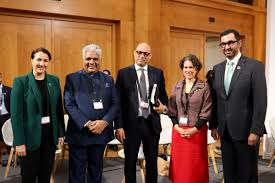
Mariam Almheiri showcases UAE’s ambitious vision and efforts to enhance global climate action during ‘Petersberg Climate Dialogue’ in Germany

Photo: During Petersberg Climate Dialogue in Germany

2 May, 2023

(WAM)

Mariam bint Mohammed Almheiri, Minister of Climate Change and the Environment, is participating in the Petersberg Climate Dialogue event this week to highlight the UAE’s efforts and ambitious vision for enhancing global climate action.

The event, which is hosted by the UAE and the Federal Republic of Germany, aims to showcase the latest initiatives, discuss ways to collaborate with various global stakeholders, and review opportunities for cooperation.

Participants in the Petersberg Climate Dialogue, which began on Monday and continued through Wednesday, include Dr. Sultan bin Ahmed Al Jaber, Minister of Industry and Advanced Technology and COP28 President-Designate, Razan Khalifa Al Mubarak, United Nations Climate Change Champion for COP28 and President of the International Union for Conservation of Nature (IUCN), as well as representatives from 40 participating countries to discuss how best to move forward in the fight against climate change.

Yesterday, Dr. Almheiri received German Foreign Minister Annalena Baerbock and various ministers and representatives of the participating countries at the UAE embassy in Berlin.

The most critical common climate and environmental issues were discussed, and Almheiri emphasised the UAE’s keenness to strengthen cooperation with friendly countries, organisations, and relevant entities to push global climate action and build an integrated system of constructive cooperation, especially with the upcoming COP28 conference in the UAE this year.

Almheiri said: “The upcoming COP conference represents a huge opportunity for all of us to find practical solutions to all the climate issues at hand and to work to employ those solutions in promoting economic and social prosperity for everyone.”

She emphasised that the UAE was the first Arab country to sign the Paris Climate Agreement and the first country in the region to announce its climate neutrality strategy by 2050.

She added that the UAE submitted its nationally determined contributions in 2015 and has committed to reducing its carbon emissions by 31 percent by 2030.

She pointed out that the UAE is undertaking significant measures to fulfil its climate goals and urged all parties to engage all active stakeholders and sectors to establish a joint mechanism that will accelerate efforts to combat climate change, work on promoting clean and renewable energy, and remove carbon from various industries.

On the first day of the Petersburg Climate Dialogue, Dr. Almheiri participated in a special session on “Just Energy Transition,” discussing topics related to carbon removal.

She emphasised the importance of removing carbon from various sectors, especially the industrial sector, to achieve emissions reduction targets.

She also pointed out that one of the main goals of COP28 meetings will be to push for a 43 percent reduction in global emissions to advance the goal of limiting global warming to 1.5 degrees Celsius.

Dr Almheiri also discussed the topic of “Renewables” in a session, explaining that the world should prioritise clean and renewable energy to reduce emissions by tripling renewable energy sources three times by 2030 and six times by 2040, in addition to doubling hydrogen production by 2030.

She also pointed out that the UAE is working hard to reduce its emissions to meet its climate commitments by adopting low-carbon technologies in the economy and investing in renewable and nuclear energy.

She mentioned that 70 percent of the UAE’s economy is non-oil.

Almheiri also discussed in the session the topic of “Financial Flows to support energy transition”, explaining that the UAE believes in the importance of the green financing for projects and efforts to enhance energy efficiency and ensure the transition to more sustainable and environmentally friendly systems locally and globally. This is highlighted through many contributions, such as supporting the Abu Dhabi Development Fund and Masdar’s accelerator platform for energy transition financing, affiliated with the International Renewable Energy Agency, and worth USD1 billion last year. Additionally, the UAE-Caribbean Renewable Energy Fund was established with a value of USD50 million to provide modern electricity services to three remote villages in Belize for the first time, in addition to focusing on developing projects in 16 Caribbean countries. This is in addition to signing a strategic partnership between the UAE and the United States of America to invest USD100 billion in implementing clean energy projects with a production capacity of 100 gigawatts in the UAE, the United States, and various parts of the world by 2035.

During the discussions, Dr. Almheiri highlighted that international cooperation is necessary to support financial flows for a just energy transition.

She pointed out that advanced countries can provide financial assistance, build capacity, and transfer technology to developing countries, enabling them to pursue low-carbon pathways while facing social and economic challenges.

Hazem Hussein

#COP28UAE

#COP28

Presidential Lecture Series, Botswana President Inclusive, sustainable trade will allow Africa to realize full potential

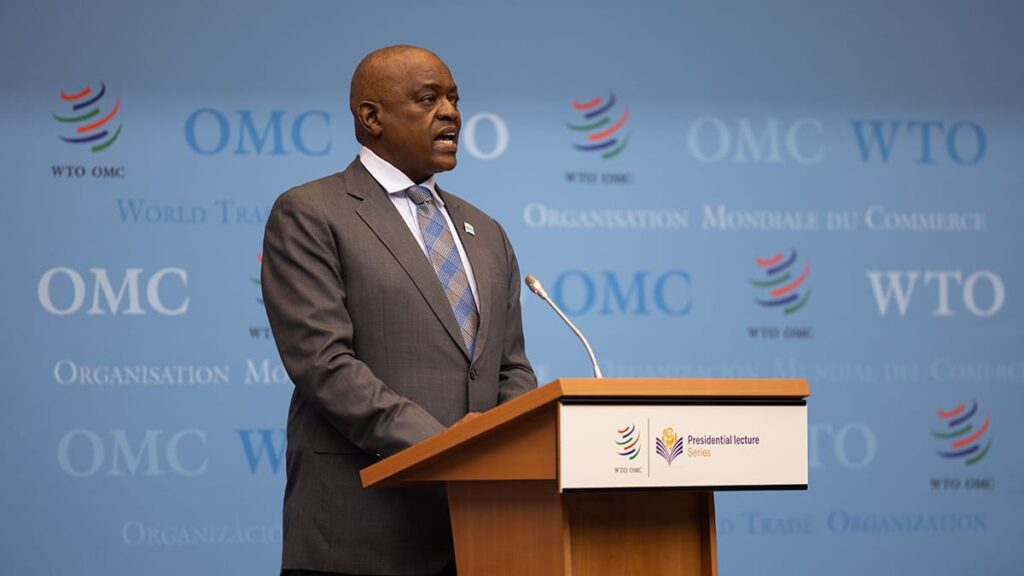
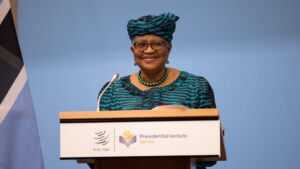
Photo: H.E. Dr Mokgweetsi E.K. Masisi, President of Botswana, at the WTO Presidential Lecture Series

Photo: WTO

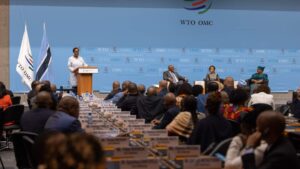
Photo: DG Okonjo-Iweala at the WTO Presidential Lecture Series
Photo:WTO

Photo: WTO Presidential Lecture Series 

Photo:WTO

2 May 2023

The WTO should work towards creating a more inclusive trading system that ensures all members of society can benefit from the opportunities that trade provides, H.E. Dr Mokgweetsi E.K. Masisi, President of Botswana, said on 2 May at an event held at the WTO as part of the Presidential Lecture Series.

In the run-up to the 13th Ministerial Conference to be held in February 2024, President Masisi called on WTO members to ensure that the concerns and interests of all developing countries, particularly those in Africa, are adequately addressed.

Botswana President: Inclusive, sustainable trade will allow Africa to realize full potential

Botswana President: Inclusive, sustainable trade will allow Africa to realize full potential

The event was opened by Director-General Ngozi Okonjo-Iweala and attended by WTO ambassadors, Swiss authorities, heads of intergovernmental organizations, representatives of non-governmental organizations, business and academia.

In her opening remarks, DG Okonjo-Iweala underscored that the aim of the WTO’s Presidential Lecture Series is “to bring leading voices from around the world to the WTO to share ideas, experiences and policy proposals and to bring fresh thinking to policymakers which they may draw upon in our efforts to use trade to deliver for people and for the planet.”

DG Okonjo-Iweala warmly welcomed President Masisi: “Since taking office in 2018, President Masisi has emerged as an outstanding and thought-provoking leader, recognized far beyond his country’s borders.” She also underscored the success achieved by Botswana, a country with less than 0.2% of Africa’s population but 1.3% of the value of Africa’s merchandise exports.

DG Okonjo-Iweala noted that Botswana — like most African countries — still faces serious challenges in terms of export diversification, creating jobs, improving skills for new generations and achieving growth that is both socially equitable and environmentally sustainable.

“President Masisi’s government has already started to answer these questions with its reset agenda, promoting digital technology and job creation for young people, especially through value chain development in key sectors, such as mining, tourism, agriculture and education,” she said.

In his speech, President Masisi stressed the historic outcome of the WTO’s 12th Ministerial Conference (MC12) in June 2022, which “brought about a revitalized sense of trust” among members. “It is evident that this renewed spirit of collaboration is essential for the successful functioning of the organization, and I would like to emphasize the importance of implementing MC12 decisions in a manner that is acceptable to all members.”

“Botswana — and I believe Africa at large — recognizes the significance of these outcomes in shaping the future of global trade. Therefore, it is imperative to ensure that the implementation process is transparent and inclusive, taking into account the diverse needs and concerns of all members. Only by doing so can the WTO build a sustainable framework for global trade that benefits all nations, particularly developing countries,” he added.

President Masisi underlined the numerous challenges that have hindered Africa’s economic development, noting in particular the impact of the COVID-19 pandemic, which saw an unequal distribution of vaccines, leaving many developing countries struggling to secure enough doses for their populations. “To address these challenges, there is a need for a coordinated global response. The WTO can play a crucial role in assisting developing countries to prepare for future pandemics.”

Underlining that Botswana graduated from least-developed country (LDC) status in 1994, President Masisi stressed that LDC graduation is a complex issue that demands a sensitive and nuanced approach to ensure that the concerns and needs of these countries are adequately addressed.

“It is imperative that the WTO devotes sufficient attention to this matter and takes into account the unique challenges faced by LDCs in their efforts to integrate into the global economy. Important lessons can be learnt from the challenges of landlocked developing countries (LLDCs) such as Botswana who have graduated to middle and upper middle-income status,” he said.

He also highlighted the significant progress towards regional integration in Africa resulting from the establishment of the African Continental Free Trade Area (AfCFTA), aimed at significantly boosting intra-Africa trade, particularly trade in value-added production and trade across all sectors of Africa’s economy. He called on WTO members to “support African countries in their efforts to create a seamless trading system within the continent, and to promote trade between Africa and the rest of the world.”

President Masisi noted that Botswana is a founding member of the WTO Informal Working Group on Trade and Gender, and has been co-chair of the Group together with El Salvador and Iceland. This shows that Botswana is actively working, both at domestic and international levels, to advocate for and promote trade policies and programmes that are gender responsive, he said.

In addition, Botswana has established the National Youth Council, which aims to empower young people and promote their participation in the development of the country. The government has also implemented various programmes to support youth employment and entrepreneurship.

The event closed with a vote of thanks by Ambassador Athaliah Lesiba Molokomme, Chair of the General Council, who expressed the hope that “the conversation held today will stimulate the discussions at the WTO that are critical to shape the future of global trade and trade relations between Africa and the rest of the world.”

WTO’s Presidential Lecture Series Launched in 2022, the lecture series provides a platform for distinguished speakers from all walks of life, ranging from presidents, prime ministers and high-level politicians to business leaders, scientists, authors and philanthropists, to discuss multilateral cooperation and global governance issues, including trade-related matters and sustainable development goals.

World Trade Organization

China’s water-saving agriculture technology benefits BRI countries

2 May 2023

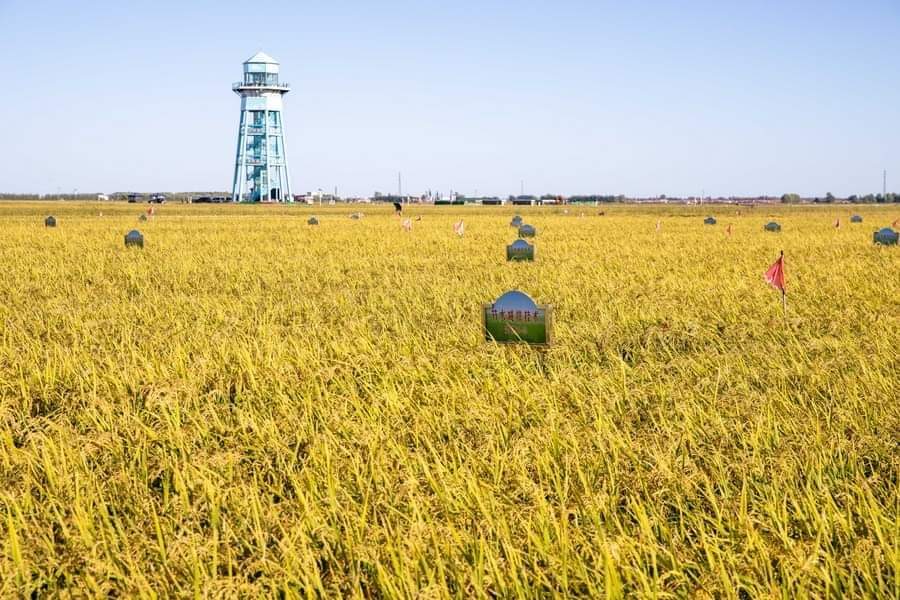
Muhammad Ali Raza, a Pakistani doctor, has recently been working on an experiment on the utilization of plastic mulch and drip irrigation in cereal-legume intercropping systems at a water-saving agricultural research station located in the city of Zhangye in northwest China’s Gansu Province.

“The crop straws are processed into mulch and used in soybean-corn compound planting fields,” Raza explained, adding that the technology can not only avoid resource waste and effectively save water but also improve soil fertility and reduce evaporation at the soil surface.

Raza, 33, came to the Gansu Academy of Agricultural Sciences (GAAS) to pursue his postdoctoral studies after the GAAS signed a memorandum with a university in Pakistan in 2022 to carry out cooperation in modern agricultural technology transformation and personnel training projects.

In recent years, GAAS has signed cooperation agreements with institutions in Pakistan, Tajikistan, Malaysia and other countries participating the Belt and Road Initiative (BRI) to conduct extensive cooperation in agricultural science and technology.

Lettuce grown in water and chili on the substrate are thriving in an intelligent greenhouse at the GAAS, thanks to the efforts of Ma Zhongming, the head of the organization.

Source: Chinese Embassy in South Africa