
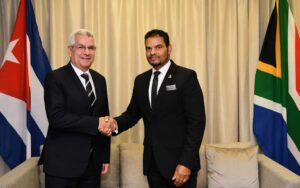
Photo: The Deputy Minister of International Relations and Cooperation, Mr Alvin Botes, with his counterpart, HE. Mr Elio Rodríguez Perdomo, Deputy Minister of Foreign Affairs of Cuba, in Pretoria.
Photo credit: Dirco
28 March 2023
On Tuesday, 28 March 2023. The Deputy Minister of International Relations and Cooperation, Mr Alvin Botes, co-chaired the 17th Joint Consultative Mechanism (JCM) with his counterpart, HE. Mr Elio Rodríguez Perdomo, Deputy Minister of Foreign Affairs of Cuba, in Pretoria.
The last JCM was held in Havana, Cuba, in July 2022. On that occasion, Deputy Minister Botes met with several Cuban Ministries and institutions.
Science and Innovation was identified as a key area of cooperation between the South African Department of Science and Innovation (DSI) and their Cuban counterparts.
The JCM is characterised by renewed commitments to continue with the implementation of the existing agreements in areas such as Health; Public Works and Infrastructure; Basic and Higher Education; Arts and Culture; Human Settlements; Science and Innovation; Sport; Trade and Economic Cooperation; Defence and Water and Sanitation.
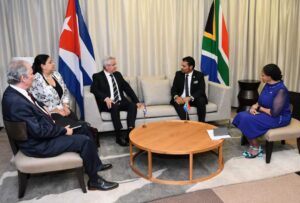
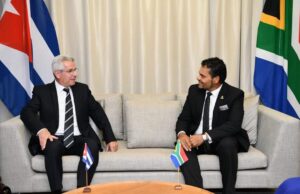
The JCM convenes annually, taking place against the backdrop of the excellent bilateral and fraternal relations of solidarity between the two countries that go far beyond the formal establishment of diplomatic relations in May 1994.
Several agreements have been signed between South Africa and Cuba, and both countries attach great importance in addressing economic, technical, and trade barriers.
Cuba chairs the Group of 77+China for 2023. For the first time in the history of the United Nations and since the founding of the G77+China in 1964, Cuba was elected as Chair of the Group of 77+China during the 77th Session of the United Nations General Assembly in September 2022.
Relations between South Africa and Cuba are significant. They were forged in the common struggle against apartheid and colonialism on the African continent.
The victory of the Cuban People’s Movement for the Liberation of Angola (MPLA) forces, fighting side by side with liberation forces against apartheid’s South African Defence Force at the battle of Cuito Cuanavale in southern Angola in 1988 paved the way for the independence of Namibia in 1990.
South Africa’s first democratically elected President, Nelson Mandela, acknowledged that the Cuban military victory at Cuito Cuanavale marked “the turning point for the liberation of our continent, and of my people, from the scourge of apartheid”.
Following South Africa’s democratic transition, South Africa and Cuba established formal diplomatic relations in 1994 and opened resident embassies in Pretoria (1994) and Havana (1995), respectively.
In 2009, Castro was honoured by South Africa on two occasions, namely the Order of the Companions of OR Tambo, as well as the Ubuntu award by the National Heritage Council.
In South Africa’s hour of bereavement, when former President Mandela passed away on December 5, 2013, Cuba sent a high-level delegation to the country, presided over by President Raul Castro, first secretary of the Central Committee of the Communist Party of Cuba.
The bestowal of the Order of Jose Marti on President Jacob Zuma in 2009 during his state visit to Cuba reflected the depth of friendship and ties between the two countries.
The same honour had previously been bestowed on presidents Mandela and Thabo Mbeki during their respective state visits to Cuba. In 2012, South Africa bestowed the Order of OR Tambo on the Cuban Communist Party veteran and internationalist Prof Jorge Risquet for his sterling contribution to the anti-apartheid struggle and the international peace negotiations that followed after the ceasefire agreement in Angola.
The pre-1994 support given for the liberation of South Africa included the education of South African students.
Many South Africans carried Cuban passports to facilitate international travel.
Cuba has, therefore, been the backbone of South Africa’s liberation despite its many own challenges. After 1994, Cuba was one of the first to offer material and human resource support.
The success of South Africa’s political bilateral and multilateral relations can, therefore, be measured in the extent of the numerous development programmes, cooperation projects as well as the strong political and social solidarity and support that exist between the two countries and peoples
Cuba is a strategic partner for South Africa in the Latin American region and within multilateral forums.
Cultural and historical ties, as well as shared struggles and common aspirations, create the basis for a strong bond of solidarity between Cuba and South Africa and the continent of Africa.
The past years of diplomatic relations between South Africa and Cuba have been marked by robust and constructive interactions at both bilateral and multilateral level.
In addition, Cuba has enjoyed the unequivocal relations between South Africa and Cuba are historic support of South Africa at the UN General Assembly, where South Africa voted in favour of a call to lift the US-imposed economic blockade against Cuba.
#SACubaRelations
#SACuba
#diplomacy
#bilateralmultilateral