
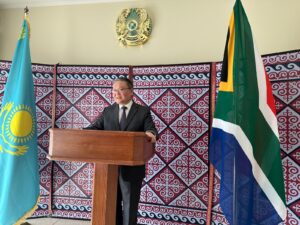
 Photo: Ambassador of Kazakhstan Mr. Yerkin Akhinzhanov briefing participants on implementation of political, social, and economic reforms in Kazakhstan
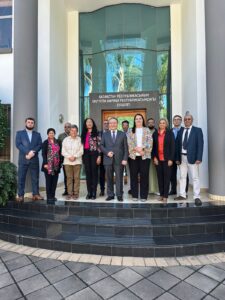
Photo: Ambassador of Kazakhstan Mr. Yerkin Akhinzhanov with some of the participants who attended the Round table on the political and economic development of Kazakhstan and the prospects for cooperation with South Africa at the Kazakh Embassy in South Africa
The Embassy of Kazakhstan in Pretoria organised a round table on the topic: The political and economic development of Kazakhstan and the prospects for cooperation with South Africa, “
The event was attended by representatives of the Department of International Relations and Cooperation and other South African governmental institutions, the diplomatic corps, representatives of business circles, academia, and mass media.
In his opening remarks, Ambassador of Kazakhstan Yerkin Akhinzhanov made
a briefing on the establishment of the gradual building a New Fair Kazakhstan, and the implementation of political, social, and economic
reforms in Kazakhstan, which has been conducted under the leadership of President Kassym-Jomart Tokayev, the outcome of the successful elections of members of the Mazhilis (Lower Chamber) of the Parliament and Maslikhats (local assemblies) in Kazakhstan, as well as the main
initiatives and goals set by the President to the new Government of the
country.
President Tokayev recommended limiting the president’s term to one term
of seven years (instead of a maximum of two five-year terms) in order to prevent the monopolization of power. Re-election to the highest state
post is prohibited.
The new electoral cycle is designed to restart the political system because of the enshrined constitutional and legislative
novelties. This will lead to more efficient and smart state governance.
Ambassador of Kazakhstan Yerkin Akhinzhanov said they were milestone achievements and results by different benchmarks obtained recently
under the leadership of President Tokayev in the socio-economic sphere.
Among them are the growth of the national economy by 3-4% and proficient surplus of the Kazakhstani budget, which was between the level of USD
7-10 billion at the end of 2022.
South African participants noted the level of ongoing democratic reforms and noted the great potential for the growth and development of
Kazakhstan. The referendum in June last year ushered in a new democratic dispensation with constitutional amendments and principles for an inclusive government expressing the will of the Kazakhs. Regulations and procedures for registering a political party were simplified to create a representative parliament, presidential powers limited with only one term in office extended to seven years. Once elected, the president gives up political party credentials and serves all Kazakhs, irrespective of
political affiliation. The direct election of mayors is also among the many other progressive reforms undertaken to position the country and
its resources to benefit all of its people.
Kazakhstan is a land linked country in Central Asia measuring 2.7 million km2, and it is the 9th largest country in land size in the world.
Located in the midst of a crossroads on the expanse of the Eurasian continent, the ancient history and nomadic culture is found in the
diversity that makes up the people of Kazakhstan. The multi-vector foreign policy of the administration is crafted on the basis of this diversity and the true spirit of mutual respect.
Today, Kazakhstan’s population stands at 20 million in one of the least densely populated countries in the world. During the Kazakh famine of 1930-1933, a tragic event in which an estimated 1,5 million Kazakhs were killed due to starvation caused by the collectivisation policies of the
Soviet Union under Joseph Stalin. Many Kazakhs left the country during this period, which made Kazakhs minorities in their own country.
Kazakhstan is a pioneer of international non-proliferation and disarmament diplomacy, having experienced the horror of nuclear weapons testing at the Semipalatinsk test site and the people and environment
still continue to be impacted by these devastating tests many decades later. Like South Africa, Kazakhstan dismantled its nuclear weapons
program recognizing that security is best achieved through disarmament.
This vast country is endowed with rich and precious mineral resources and agricultural land and is turning the disadvantage of being a land-locked country to a land-linked country with untold potential.
Kazakhstan holds the largest uranium reserves in the world and is the largest producer of this radioactive fuel, and it is also abundant with gas, oil, and coal energy resources and reserves.75% of the land is
suitable for agricultural production, most of which is being used to rear livestock and for grazing.
South Africa and Kazakhstan share the endowment of mineral resources and agriculture. Both countries have an opportunity for collaboration and cooperation in these sectors as well as in mining and are moving forward to increase trade and commercial exchanges between the countries.
14 billion U$D worth of Foreign Direct Investment (FDI) was attracted into Kazakhstan. The establishment of the International Finance Centre
Astana (IFCA) in 2018 created a competitive, efficient, and transparent financial market in Kazakhstan. It also revised the rules and regulations for trading on the International Stock Exchange of Astana
(ISEA).
The courageous action by the Kazakhs is to change the constitution of the country and transform into a government that listens to its people
and creates and implements policy accordingly is commendable and serves
as an example for many nations trying to innovate better, more efficient, and
effective systems of governance.
Participants noted the great potential of cooperation between Kazakhstan
and South Africa, in particular, in the areas of bilateral trade,
investments, tourism, and cultural exchange. Kazakhstan and South
Africa, who last year celebrated the 30th anniversary of their
diplomatic relations may be geographically distant from each other, but
distances matter a little, when nations build cultural bridges.
By: TDI