
Photo: Creator Paz y Cooperación
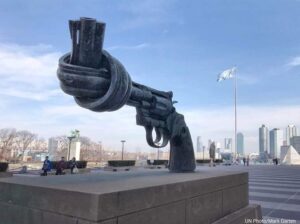
Photo: UN Photo/Mark Garten
24 April was established by the UN General Assembly in 2018 as the International Day of Multilateralism and Diplomacy for Peace following a declaration by a Ministerial Meeting of the Non-Aligned Movement (NAM).
Multilateralism is usually defined as collaboration between several countries in pursuit of a common goal, where other parties such as civil society or the private sector may also be involved.
Preserving the values of multilateralism and international cooperation, which underpin the UN Charter and the 2030 Agenda for Sustainable Development, is fundamental to promote and support the three pillars of the UN: peace and security, development and human rights.
The international norms and rules-based system that have steered nations through seven decades must rise to meet the mounting challenges of protectionism and isolationism. Global issues such as climate change, geopolitical tensions, humanitarian and migratory crises are cross-cutting, implicating the values and interests of nations. They require collective attention and action. Technological advancement has also impacted the political and socio-economic landscape and inter-state relations
The International Day of Multilateralism and Diplomacy for Peace seeks to reaffirm the UN Charter and its principles of resolving disputes among countries through peaceful means. The Day acknowledges the use of multilateral decision-making and diplomacy in achieving peaceful resolutions to conflicts among nations.
It was established on the 12th of December 2018 through resolution A/RES/73/127 and was first observed on the 24th of April 2019. Since then it is observed annually on the 24th of April.
Multilateralism is not simply a practice or a question of the number of actors involved. It involves adherence to a common political project based on the respect of a shared system of norms and values. In particular, multilateralism is based on founding principles such as consultation, inclusion, and solidarity. Its operation is determined by collectively developed rules that ensure sustainable and effective cooperation. In particular, they guarantee all actors the same rights and obligations by applying themselves continuously (and not on a case-by-case basis, depending on the issue handled). Multilateralism is, therefore, both a method of cooperation and a form of organization of the international system.
Multilateralism is part of the United Nations DNA. The Charter does not simply define the structure, mission and functioning of the Organisation. It is one of the pillars of the international system in which we live today. In his report on the work of the United Nations to the General Assembly in 2018, the United Nations Secretary-General António Guterres recalled that the Charter remains the “moral compass to promote peace, advance human dignity, prosperity and uphold human rights and the rule of law.” (Guterres, 2018).
While the United Nations has been the multilateral framework par excellence for more than 75 years, multilateral processes have diversified. One of the most visible developments in multilateral diplomacy is undoubtedly represented by the increase in the number of Member States: from 51 in 1945 to 193 today. In addition to this horizontal expansion, the multilateral framework has also expanded vertically, including new actors, such as non-governmental organizations (NGOs), private actors, and other international organizations. Today, more than 1,000 NGOs and international organizations have observer status at the United Nations.
The United Nations came into being in 1945, following the devastation of the Second World War, with one central mission: the maintenance of international peace and security. The Charter of the United Nations states that one of the United Nations purposes and principles is the commitment to settle disputes through peaceful means and the determination to succeeding generations from the scourge of war.