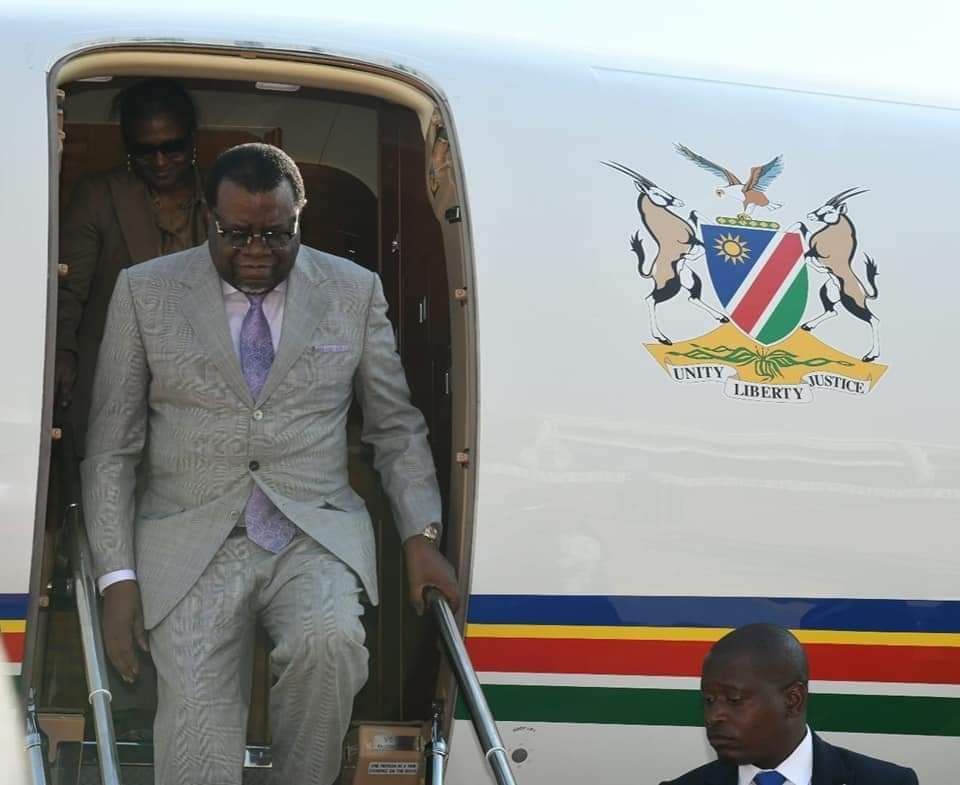
The Minister of International Relations and Cooperation, Dr Naledi Pandor welcomes the President of the Republic of Namibia, HE Hage Geingob, upon his arrival for the State Visit to South Africa.

Photo: President of the Republic of Namibia, HE Hage Geingob, upon his arrival for the State Visit to South Africa.

Photo: The Minister of International Relations and Cooperation, Dr Naledi Pandor accompanied by Mr Thulas Nxesi, Minister of Employment and Labour welcomes the President of the Republic of Namibia, HE Hage Geingob, upon his arrival for the State Visit to South Africa.


The Minister was accompanied by Mr Thulas Nxesi, Minister of Employment and Labour.

President Cyril Ramaphosa will host His Excellency President Hage Geingob of the Republic of Namibia who will undertake a State Visit to the Republic of South Africa on Thursday, 20 April 2023.

The visit aims to solidify bilateral relations between the two countries and it is expected that President Ramaphosa and President Geingob will discuss political and economic issues including regional, continental and international matters of mutual concern, including exchanging views on the political situation in Eswatini, conflict in Saharawi Arab Democratic Republic (SADR), Palestine and the Russia – Ukraine situation.

South Africa and Namibia enjoy close historic relations and the structural bilateral relations between the two countries is conducted under the framework of a Bi-National Commission (BNC) inaugurated in 2013.

The State Visit by President Geingob will afford the two countries an opportunity to solidify their bonds of friendship through assessing progress made in the implementation of the decisions of their BNC.

The visit will also afford the two countries an opportunity to enhance economic cooperation; explore trade and investment; and identify new areas of cooperation.

 In 2022, South Africa imported R16.1 billion from Namibia and in turn South Africa exported R56.5 billion to Namibia.

The second session of the South Africa-Namibia BNC was held in South Africa in October of 2016. The third session is scheduled to be hosted by Namibia and meetings, at senior officials level, are underway planning for this meeting.

The State Visit will be preceded by a bilateral meeting between the Minister of International Relations and Cooperation (DIRCO), Dr Naledi Pandor and Ms Netumbo Nandi-Ndaitwah, Minister of International Relations and Cooperation of the Republic of Namibia on 19 April 2023.

Namibia is a member of the Southern African Customs Union (SACU) and President Geingob Chairs the SADC Organ on Politics, Defense and Security Cooperation.

The last State Visit to the Republic of South Africa by the Republic of Namibia took place in November of 2012, by former President Hifikepunye Pohamba.

#NamibiainSA

#SANamibiaRelations 🇿🇦🇳🇦

South Africa- Norway Relations🇿🇦🇳🇴

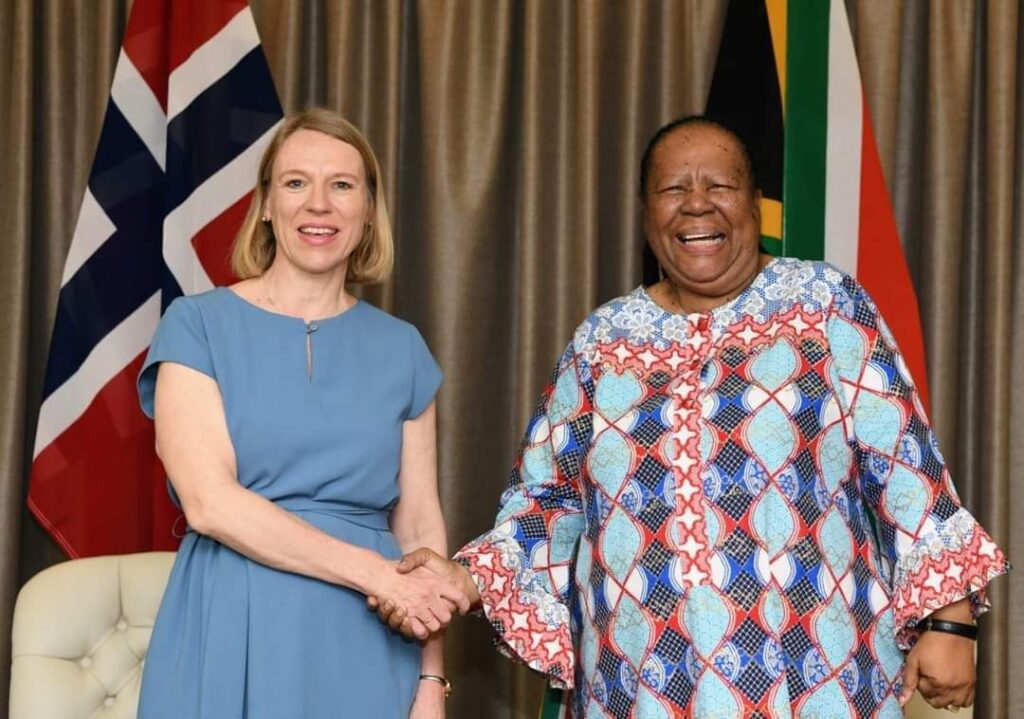
Photo: The Minister of International Relations and Cooperation, Dr Naledi Pandor, and her counterpart Minister of Foreign Affairs of Norway, Ms Anniken Huitfeldt


On Wednesday, 19 April 2023 . The Minister of International Relations and Cooperation, Dr Naledi Pandor, hosted the Minister of Foreign Affairs of Norway, Ms Anniken Huitfeldt, for the Sixth Session of the South Africa–Norway High-Level Consultations.

The session reviewed the status of bilateral political and economic relations.

🇿🇦🇳🇴

South Africa and Norway enjoy excellent political and economic relations and cooperate on a wide range of interlinking global issues, including global health, climate change, energy, sustainable blue economy, peace and reconciliation.

South Africa’s exports to Norway includes fuels, chemicals, engineering products, and raw materials. South Africa mainly imports products such as foodstuffs, raw materials, fuels, chemicals, semi manufactured products, and engineering products.

#WPS

#sanorwayrelations

#SANorwayRelations🇿🇦🇳🇴

The World Food Programme (WFP) 

Humanitarian Aid to Sudan operations puts on hold, following death of 3 staff in unrest

The World Food Programme (WFP) has temporarily halted all operations, as a result of the fighting between rival military groups in Sudan, which led to the deaths of three WFP employees on Saturday. The UN Secretary-General has called for those responsible to be brought to justice.

According to a statement attributable to the Executive Director of the UN agency, Cindy McCain, the workers were carrying out life-saving duties in Kabkabiya, North Darfur.

In a separate incident on Saturday, a WFP-managed UN Humanitarian Air Service (UNHAS) aircraft was significantly damaged at Khartoum International airport during an exchange of gunfire, seriously impacting WFP’s ability to move humanitarian workers and aid within the country.

In the statement, Ms. McCain explained that all operations in Sudan have been suspended, pending a review of the evolving security situation.

“WFP is committed to assisting the Sudanese people facing dire food insecurity,” said Ms. McCain, “but we cannot do our lifesaving work if the safety and security of our teams and partners is not guaranteed. All parties must come to an agreement that ensures the safety of humanitarian workers on the ground and enables the continued delivery of life saving humanitarian assistance to the people of Sudan. They remain our top priority.”

Any loss of life in humanitarian service is unacceptable and I demand immediate steps to guarantee the safety of those who remain.

Ms. McCain emphasized that threats to WFP teams make it impossible for them to operate safely and effectively in the country and carry out the UN agency’s critical work.

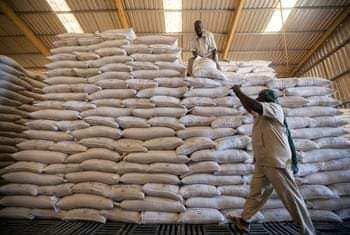
Photo: World Food Programme (WFP) staff members load bags of split yellow peas onto a truck in a WFP warehouse based in El Fasher, North Darfur, Sudan

© UN Photo/Albert Gonzalez Farran World Food Programme (WFP)

UN system at the AfCFTA Business Forum

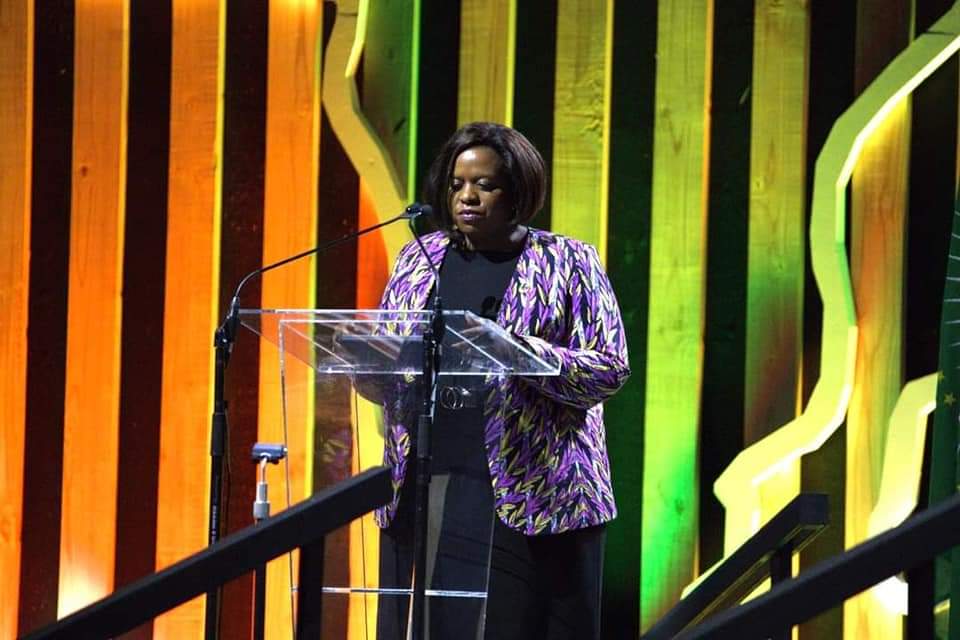
The CEO and Executive Director, Sanda Ojiambo, represented the UN system at the #AfCFTA Business Forum, where she reiterated our commitment to the African Continental Free Trade Area. Reducing trade barriers and increasing private sector investments are essential to unlocking #Africa’s potential.

However, progress toward the Sustainable Development Goals in Africa and the rest of the world has stalled and even reversed. To galvanize sustainability action for Africa, the UN Secretary-General launched the Global Africa Business Initiative (GABI) — a unique platform connecting leaders to invest in Africa’s unstoppable growth.

GABI brings the collective efforts of the United Nations Global Compact, United Nations Development Programme – UNDP, UN Office of the Special Adviser on Africa, UNECA and private sector participants to support Africa’s accelerated and sustainable prosperity.

At a CEO Dinner hosted by the United Nations in South Africa, we joined our #LocalNetwork colleagues in introducing GABI’s 2023 priorities, reflecting on Africa’s unique challenges and potential in energy, digital transformation, and inclusive growth and trade. The event welcomed input on how the business community can accelerate change in these areas and drive responsible investments.

The United States became the 4th WTO member to submit acceptance of the Agreement on Fisheries Subsidies. 

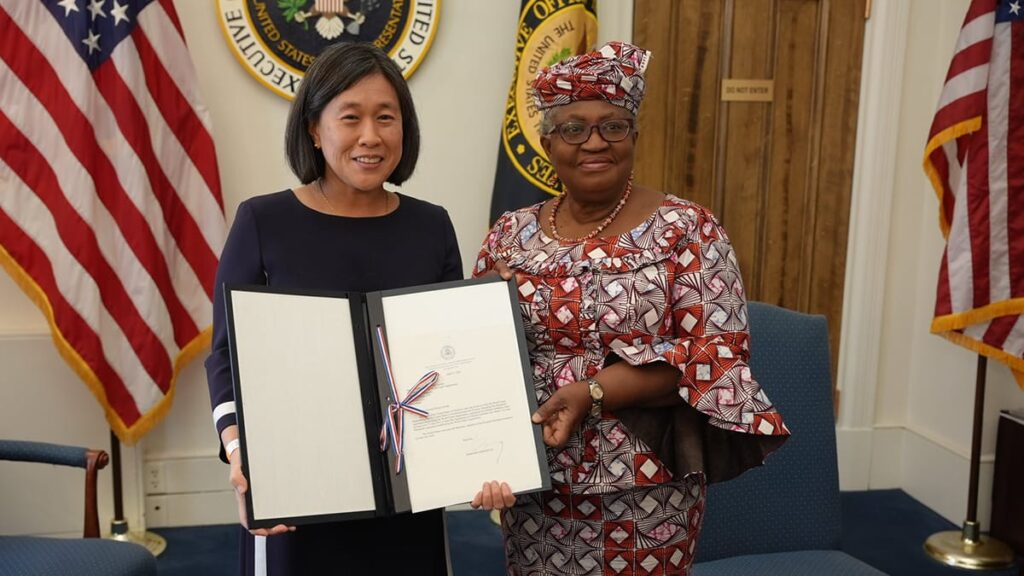
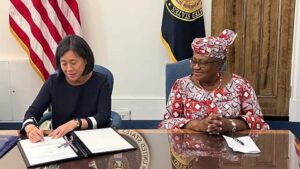
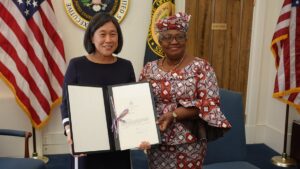
Photo: U.S. Trade Representative Ambassador Katherine Tai presenting the instrument of acceptance to Director-General Ngozi Okonjo-Iweala in Washington, D.C.

U.S. Trade Representative Ambassador Katherine Tai presented the instrument of acceptance to Director-General Ngozi Okonjo-Iweala in Washington, D.C.

The United States deposited its instrument of acceptance for the Agreement on Fisheries Subsidies on 11 April, making it the fourth WTO member and the first among the large fishing nations to do so. The formal acceptance by the United States marks a pivotal moment for the approaching entry into force of the landmark agreement for ocean sustainability, said Director-General Ngozi Okonjo-Iweala as she received the instrument from U.S. Trade Representative Ambassador Katherine Tai in Washington, D.C. Acceptances from two-thirds of WTO members are needed for the Agreement to come into effect.

United States formally accepts Agreement on Fisheries Subsidies United States formally accepts Agreement on Fisheries Subsidies

DG Okonjo-Iweala said: “I am delighted and grateful to receive the United States’ formal acceptance of the WTO’s Agreement on Fisheries Subsidies. This strong show of support by the United States for the WTO’s work toward ocean sustainability marks a pivotal increase in momentum among the membership to ensure this landmark agreement enters into force. US leadership is vital to the WTO and to multilateralism. I look forward to continuing to work with the United States to ensure that the WTO responds to the needs of people and the planet.”

United States Trade Representative Katherine Tai said: “The United States has been a leader in protecting our shared environment from harmful and unsustainable practices, including our oceans and marine resources — and those whose livelihoods depend on them.”

“We are proud to be among the first WTO members to accept this agreement, which is the first ever multilateral trade agreement with environmental sustainability at its core. It will help improve the lives of fishers and workers here in the United States and elsewhere, and we look forward to building on this agreement with other WTO members,” Ambassador Tai said.

Adopted by consensus at the WTO’s 12th Ministerial Conference (MC12) held in Geneva on 12-17 June 2022, the Agreement on Fisheries Subsidies sets new binding, multilateral rules to curb harmful subsidies, which are a key factor in the widespread depletion of the world’s fish stocks. In addition, the Agreement recognizes the needs of developing and least-developed countries (LDCs) and establishes a fund to provide technical assistance and capacity building to help them implement the obligations.

The Agreement prohibits support for illegal, unreported, and unregulated (IUU) fishing, bans support for fishing overfished stocks, and ends subsidies for fishing on the unregulated high seas. Members also agreed at MC12 to continue negotiations on outstanding issues, with a view to making recommendations by MC13 for additional provisions that would further enhance the disciplines of the Agreement.

The full text of the Agreement can be accessed here. The list of members that have submitted their acceptance of the Agreement is available here.

Information for members on how to accept the Protocol of Amendment is available here

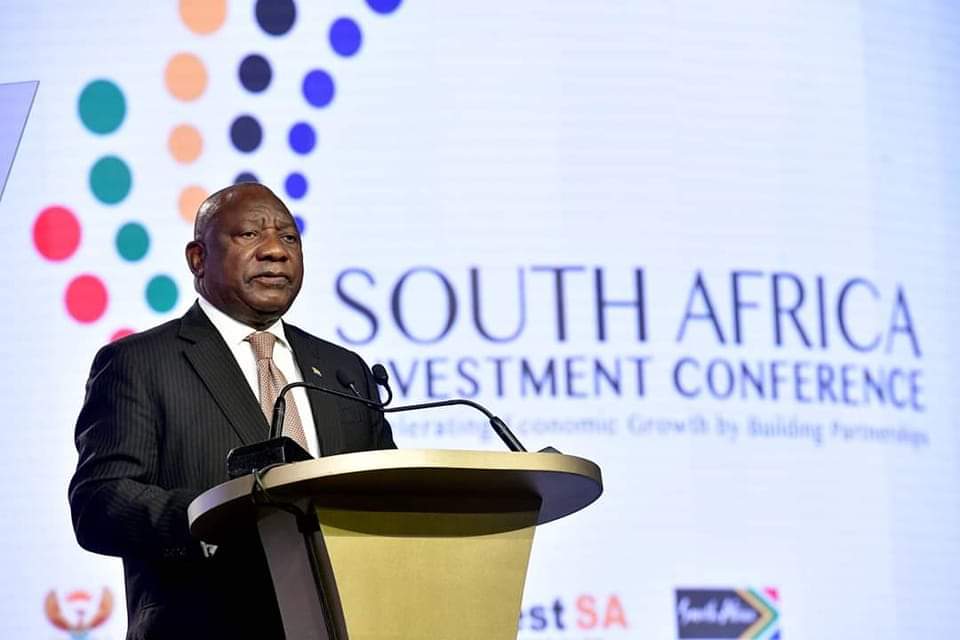
President Cyril Ramaphosa will open and address the South Africa Investment Conference on Thursday, 13 April 2023

South Africa Investment Conference (SAIC) is attended by delegates from varying industries in South Africa and across the world and will take place at the Sandton Convention Centre in Johannesburg.

In its 5th year since inception, President Ramaphosa convened the South Africa Investment Conference with an objective of achieving R1.2 trillion in investments targets. Investors heeding the call, have over the last four conferences, declared R1.14 trillion in investment commitments.

Of the 152 investment announcements made previously, 45 projects have already been completed, while a further 57 projects are currently under construction. These investments have resulted in new factories, call centres, solar power plants, undersea fibre optic cables, expansion of production lines and the adoption of new technologies.

Importantly, the new investments also significantly contribute to South Africa’ national goals of socio-economic development to create sustainable jobs, reduce poverty and drive back inequality. These investments have also contributed to a substantial increase in local production and encouraged efforts to buy local.

President Ramaphosa will address the opening of the South Africa Investment Conference on the Thursday morning and also take part in the panel discussion on “South Africa: Resolving the Energy Crisis”. Companies’ significant investments will be pronounced in the opening session .

Delegates at the conference will be treated to an a la carte of breakaway sessions ranging from discussions on: Digital opportunities in SA: stories from the tech ecosystem; Agriculture: new products and markets; Infrastructure: Investment opportunities through the investment fund; Tourism, Digital and Creative Economy; Capital markets: facilitating investment in SA and providing access to capital; The Just Energy Transition in South Africa; Mining: A new partnership for growth; Manufacturing: deepening supply chains and building regional value chains and Local growth strategies – a provincial focus.

The breakaway sessions, taking place simultaneously, are open to all media and will have Ministers of Government and leading industry experts partake.

In the afternoon, President Ramaphosa will officiate at the closing and announcement ceremony of the 5th South Africa Investment Conference. The 4th SAIC raised R367 billion in investment commitments, bringing the five-year investment target firmly into sight. Later, the President will host a business and awards dinner in honour of investors and companies participating at the SAIC.

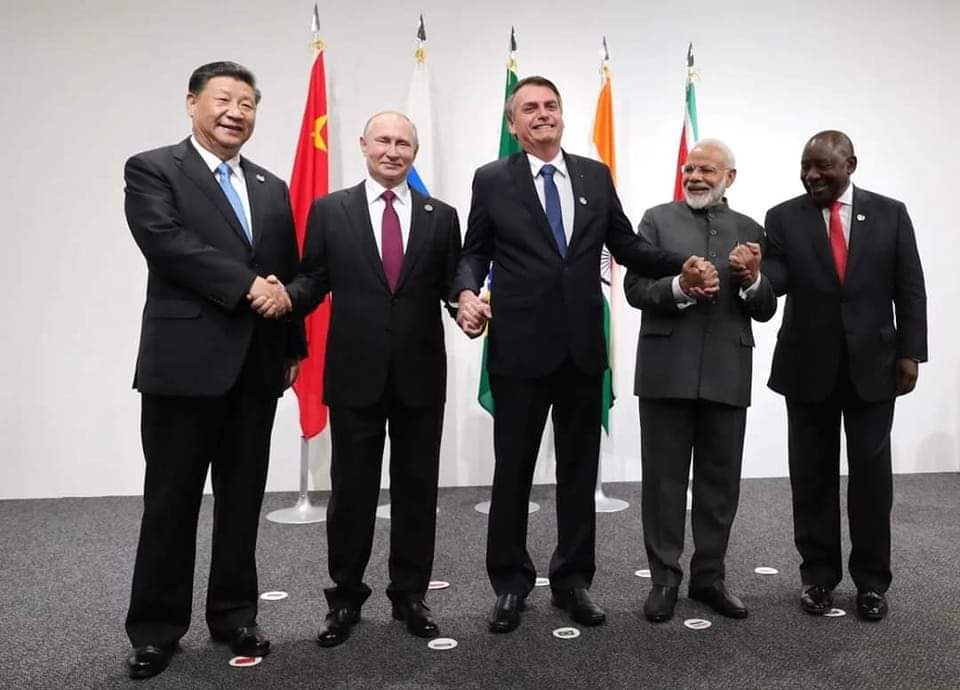
The BRICS group

The BRICS group, comprising the world’s five major developing economies, has overtaken the Group of Seven (G7) by making up a larger share of the global gross domestic product (GDP) based on purchasing power parity, data compiled by Acorn Macro Consulting, a UK-based macroeconomic research firm, shows.

According to the findings, the bloc of BRICS countries (Brazil, Russia, India, China, and South Africa) contributes 31.5% of the world’s GDP. Meanwhile, the G7, consisting of the US, Canada, France, Germany, Italy, Japan, and the UK, and considered the most advanced economic bloc of countries on the planet, add up to 30.7%.

The gap between the two groups is expected to grow, analysts say, as China and India are experiencing robust economic growth, and more countries are interested in joining BRICS.

#brics #brazil #russia #india #china #southafrica #groupof7 #groupofseven #G7

The Diplomatic Informer Magazine SA Wishes Everyone a Happy and Blessed Easter

The Diplomatic Informer Magazine SA wishes Everyone a Happy and Blessed Easter. As Christians around the world commemorate the resurrection of Christ today, 9th April 2023, Easter Sunday.

Easter the celebration of the resurrection of Jesus from the tomb on the third day after his crucifixion. Easter is the fulfilled prophecy of the Messiah who would be persecuted, die for our sins, and rise on the third day.

Remembering the resurrection of Jesus is a way to renew daily hope that we have victory over sin. According to the New Testament, Easter is three days after the death of Jesus on the cross.

Easter is a very significant date within Christianity and is the foundation of the Christian faith. Jesus, the Son of God, fulfilled prophecy and through his death, has given the gift of eternal life in heaven to those who believe in his death and resurrection.

#HappyEaster

#EasterSunday2023

#EasterSunday

The Astana International Forum will take place in the capital of Kazakhstan this June. At this dynamic gathering, energy and climate will be key topics for discussion

By Assel Nussupova in Astana International Forum, OP-ED

For Kazakhstan, the energy sector development is a highly relevant issue, touching on the country’s economic survival. Kazakhstan is a leading energy producer in the region, with vast oil and gas resources located in the western part of the country. According to the latest BP estimates, Kazakhstan has 30 billion barrels of proven oil reserves. Almost 80 percent of the Kazakh oil output is exported and is currently being supplied to international, mostly European markets.

Kazakhstan has been an oil producer since 1911. Although the country did not begin extracting significant levels of oil until the 1960s and 1970s, during the Soviet era, it was the second-largest republic in terms of possession of oil reserves and the second-largest oil producer among the Soviet republics. In the Soviet bloc, only Russia had a greater oil share. With the breakup of the Soviet Union, Kazakhstan’s reliance on oil has become vital for the country’s survival as an independent country. In 2003, Kazakhstan exceeded 1 million barrels a day in oil production for the first time. This staggering success was partly due to the country’s ability to attract large foreign direct investment inflows to support the oil industry.

From the early days of the country’s independence, oil and gas industries have helped support Kazakhstan’s development and allowed it to maintain decent living standards for its population. Thirty-one years later, the oil and gas sector is still “responsible” for the country’s stable development, accounting for more than a third of Kazakhstan’s GDP.

The majority of Kazakhstan’s oil wealth comes from three giant oil fields: Tengiz, Karachaganak, and Kashagan. Tengiz, named for the Kazakh word for “sea,” was discovered by Soviet geologists in 1979 in a “remote, windblown steppe on the northeast shore of the Caspian,” as the Washington Post once put it. Today, Tengiz is the world’s deepest-producing oilfield. According to Chevron’s official website, Tengiz is also the largest “single-trap producing reservoir.”

On April 6, it will be thirty years since the American company Chevron, then the fifth-largest private oil company in the world, signed a forty-year contract with the Kazakh government to develop the Tengiz field in western Kazakhstan. Today, Chevron holds 50 percent of Tengizchevroil, a joint company that was created in 1993 to operate the Tengiz oil field and the nearby Korolev oil field. These two oil fields have a lucrative amount of recoverable crude oil reserves estimated in the range of 890 million to 1.3 billion tons (7.1 to 10.9 billion barrels). In 2016, the company decided to proceed with an expansion project at Tengiz to bring overall production up to 850,000 barrels a day. According to the latest updates, the expanded production facilities will begin operating in 2024.

Besides Tengizchevroil, Chevron is involved in another large joint venture with Kazakhstan – Karachaganak Petroleum Operating B.V. (KPO). In this venture, the Americans hold an 18 percent equity interest. The Karachaganak oil and gas field is another large energy-producing field in Kazakhstan and one of the world’s largest oil and gas reserves. Production at Karachaganak began during the Soviet era in 1984. According to the latest available data from the Economist Intelligence Unit (EIU), this field has produced between 220,000 and 250,000 barrels a day over the past decade.

In addition to the Tengiz area and Karachaganak oil field, Kazakhstan possesses its most precious oil asset – the Kashagan offshore oil field in the northern Caspian Sea. It is the largest oil field discovered in Kazakhstan to date. Production at this field started relatively recently, in 2013. Like Tengiz, the field will undergo an expansion project, with investors and the Kazakh government hoping to increase oil output to 500,000 barrels a day by 2025 and approach the million-barrel-a-day mark by 2042.

These three supergiant oil fields provide nearly two-thirds of Kazakhstan’s oil output. In a sense, their contribution helps to keep the country financially and economically stable. However, Kazakhstan’s dependence on the energy sector is not without significant risks to its sustainable development. As a landlocked and isolated country located far away from international oil markets, Kazakhstan remains highly dependent on Russia for transporting its oil to world markets. More than 90 percent of exported Kazakh oil still flows to the Russian port of Novorossiysk through the Caspian Pipeline Consortium. This same pipeline also carries some oil produced by Russian companies.

This is problematic given the current military conflict in Ukraine. The conflict between Russia and Ukraine has resulted in serious supply chain disruptions and caused many Western nations to impose sanctions against Russia, Kazakhstan’s major trade and economic partner. The export disruptions have put huge pressure on Kazakhstan’s investment profile and the economy and well-being of the Kazakh people.

With energy prices currently set at a high level, Kazakhstan remains resilient during the regional instability caused by the conflict in Ukraine. However, if the conflict continues to escalate and does not reach any clear-cut resolution, and if oil prices are to go down in the nearest future, as forecasted by many international experts, Kazakhstan will have to deal with increased difficulties such as growing budget constraints, limitations in supporting the government’s expansive social security programs and further pressure on its monetary policies and exchange rate.

According to the latest estimates by the EIU, “Kazakhstan’s trend growth rate will slow from the 4.4 percent recorded over the past decade to an annual average of 3.8 percent in 2024-27.” The EIU experts emphasize that Kazakhstan’s economic growth “will be supported by activity” in the energy sector. According to their most recent report, the contributing factors towards the economic growth of Kazakhstan will all be related to developments in the energy sector. In particular, these factors include the expansion of the Tengiz oil field that, as mentioned above, is planned to come on line next year; KazMunayGas’ joint venture (together with the Russian company Lukoil) to restart the Zhenis offshore exploration project in the Caspian Sea, and new projects that will result from investment cooperation with the European Union and China.

Collaboration with the EU is promising to bring significant benefits to Kazakhstan’s economy as the EU has enforced an almost full embargo on oil imports from Russia. This embargo provides an excellent opportunity for Kazakh oil producers to enter the European market and supply it with Kazakh oil. Partnership with China also promises potential gains for Kazakhstan.

It is timely that the upcoming Astana International Forum will feature energy and climate discussions. The forum will provide an excellent opportunity to bring together government and private sector stakeholders, facilitating helpful dialogue on these key issues.

The author is an analyst with a Master’s Degree in Economics from Georgetown University in Washington, DC, with more than 20 years of experience working for the Kazakh government. She focuses on macroeconomics, commodity, financial markets, and economic and social policies in Kazakhstan and globally.

Astana Times

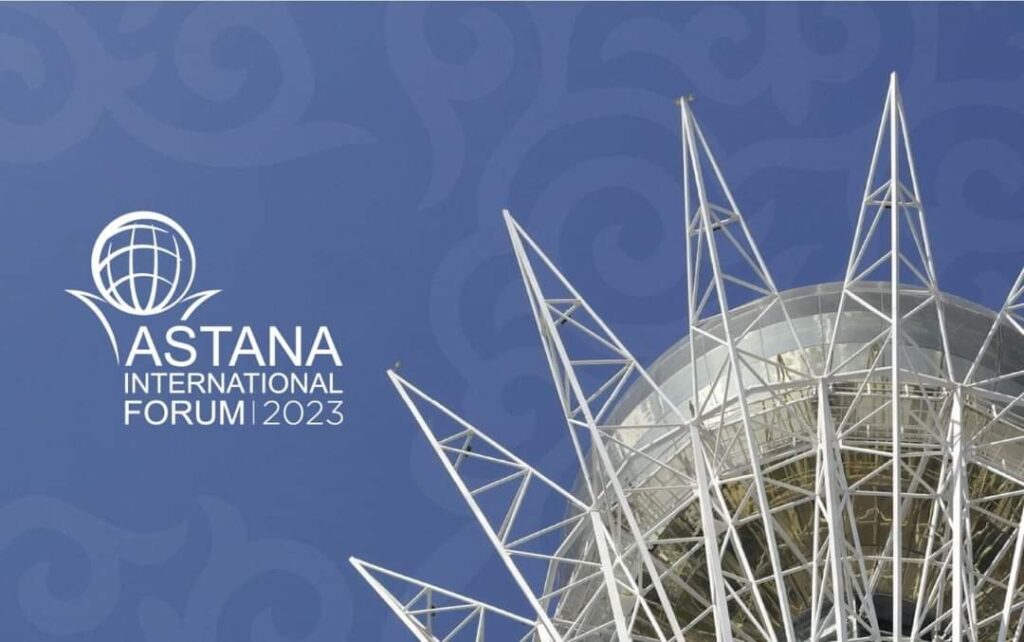
Photo: Official poster of Astana International Forum 2023.
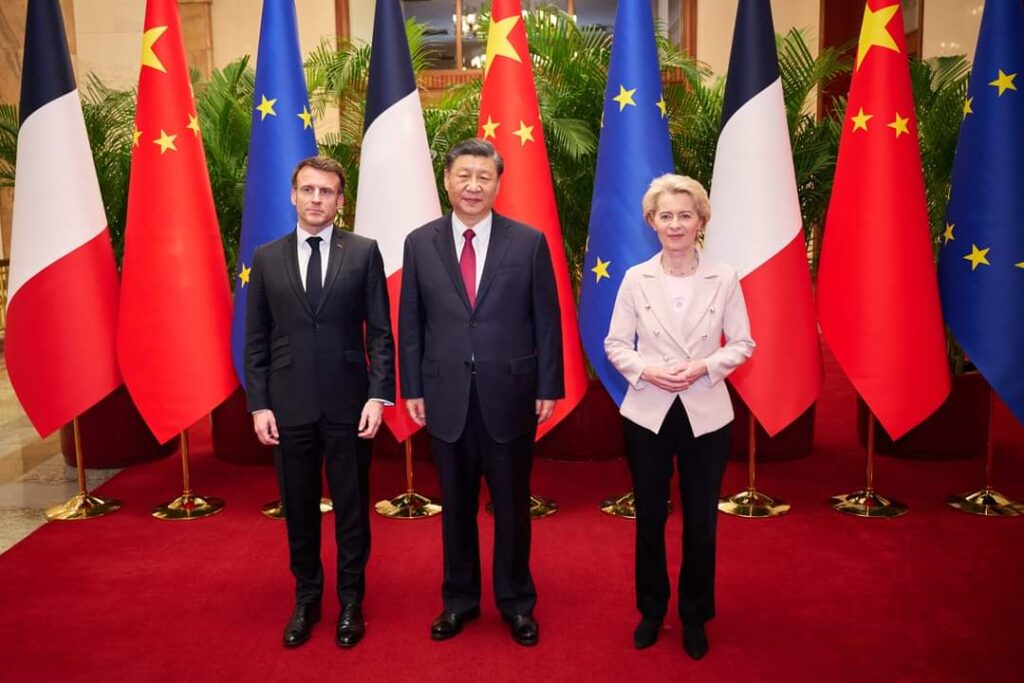
EU-China relations are extensive and complex

How we manage them will impact EU prosperity and security. This relationship – and its future – have been at the core of President Ursula von der Leyen’s visit to Beijing.

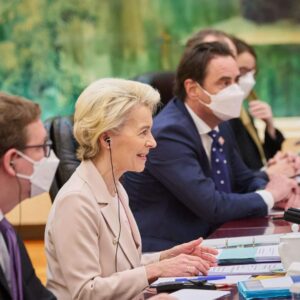
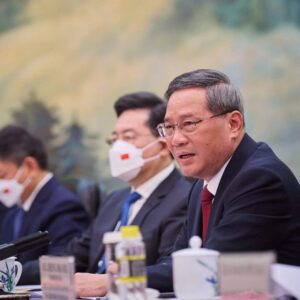
With Premier Li, President von der Leyen discussed how to rebalance our trade and mentioned during her press conference the possibility to resume our High Level Economic and Trade Dialogue to engage on this.

The meeting with President Xi and President Emmanuel Macron has been the opportunity to address imbalances in our economic relations and look at cooperation on pressing global issues like Russia’s war and global change climate.

Together with China, we have the duty to uphold and promote the rules-based international order. Starting with the end of the Russian invasion and withdrawal of its troops.

President von der Leyen highlighted the need to address imbalances and risks stemming from dependencies and export of sensitive tech, and to remain vigilant on China’s actions on Ukraine.

She also stressed our concerns on human rights.

#EuropeanUnion