COURSE TOWARDS BUILDING NEW KAZAKHSTAN IS WELCOMED IN SOUTH AFRICA OPINION BY THE LEADERSHIP of the Thembekile Mandela Foundation & G-Global Africa Johannesburg, South Africa


19 March 2021

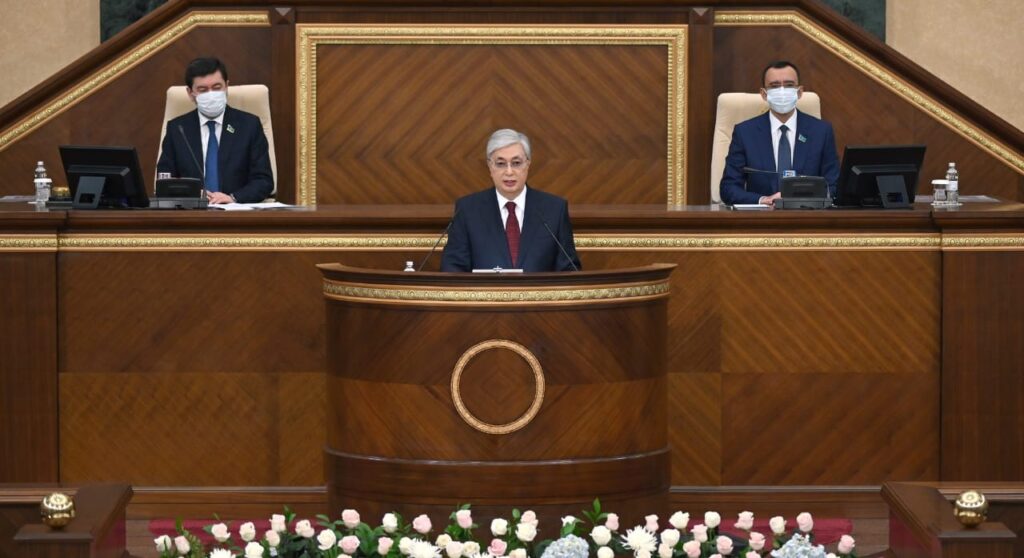
President H.E. Mr Kassym-Jomart Tokayev of Kazakhstan, delivering on 16 March 2022 his truly historic State of the Nation Address under the
theme: ” NEW PATH OF RENOVATION AND MODERNIZATION”,
managed to show outstanding qualities of a wise leader.

This year’s SONA by Kazakh President was made against a backdrop of the unprecedented after the Cold War world turbulence. Our first observation is that this evolving fact did not distract the Head of State much to concentrate strictly on the external matters, inter alia, regional geopolitical agenda. This SONA was heavily focused on aspirations of the People of Kazakhstan, as it should be, according to our reckoning.

The President prioritized, above all, the importance of solidifying the
cherished Independence of Kazakhstan as its citizens’ main and sacred
asset. This cannot be overemphasized in light of what is happening in
that part of the world now. Freedom and Independence cannot be taken as granted things, and any modern wise leader should be emphasizing the
criticality of such matters, like Liberty and Sovereignty, as today’s
people must handover them for the succeeding generations. The history of post-Apartheid in south Africa is equally instructive in this regard.
That is why Madiba Nelson Mandela, recognized as iconic leader all over the globe, urged civilization to continue long walk to freedom.

Secondly and wisely so, President Tokayev reaffirmed the strategic
intent to building a stronger New Kazakhstan based on economics and political reforms that are in step with a modern world, as well as recent aspirations of all the people on the planet.
A constantly reforming and evolving state keeps its relevance both today and in the future for all its nationals. The combination of
economic and political reforms is what underpinning the adequate standard of living. This is also an important foundation for prosperity and sustained human rights.

Elaborating further on political reforms, Kazakh leader highlighted the
importance of rejecting super-presidential system of governance, with transfer to a model with a strong presidency without excessive powers, backed by influential democratic parliament with greater participation by the citizenry that creates an accountable government. It is good to hear about such novelties, as they will provide a barrier to corruption and abuse of power at all levels.

Today in every part of the world, national constitutions are gradually but increasingly meeting the global benchmark of high level of freedoms by ensuring the representation of people in power, as well as accountability of governments to its nationals, much like South Africa’s constitution is held in high regard the world over. To this end, various
clarifications on constitutionality matters for ordinary people, as well as both prosecutors and ombudspersons are of utmost significance
everywhere. It this vein, the transformation of the Constitutional Council into the Constitutional Court is also deserving every commendation. Yet, in accordance with the international practice, such innovation will more effectively enforce the provisions of the Basic
Law. For us, as human rights activists, this initiative is also an
important step, as its builds more just and balanced legal state, which protects the constitutional rights of its citizens.

Reforms to the electoral and representative systems, as well as the
administrative-territorial structure are equally sweeping and detailed.
In particular, the creation of three new provinces (Abai, Jetisu and
Ulytau) will give additional dynamism, ensuring regional fairness and
economic effect. And switching to a mixed proportional-majoritarian
model, when Mäjilis (lower house of Parliament) as well as provincial and metropolitan Maslikhats (local representative bodies) will be formed
70% proportionally and 30% majoritarily will ensure harmony, as it will
fully reflect the rights of all citizens. The functionality of the
Mäjilis will be expanded. It will be vested with the exclusive right to
pass laws, with the possibility to overcome the objections of the
Senate. In turn, the powers of the Senate will be supplemented with the right to approve candidates for the positions of chairmen of the Constitutional Court and the Supreme Judicial Council. Mäjilis
henceforth will control the quality of execution of the state budget.
The Chairman of the Supreme Audit Chamber (new body to be established instead of Accounts Committee, non-accountable to Parliament) will report twice a year to the lower chamber. These three reforms seem to us
to be a most fully reflecting the interests of the Kazakhstani nationals both on national and regional levels. Moreover, they will enhance inclusivity and accountability. On the other hand, no tier of government from the Executive and Legislative Authorities, as well as the
Judiciary, have been held as ‘holy cows’ or ‘untouchables’. It is this
principle that will ensure comprehensive reforms at all levels. And then
the Kazakh authorities will increasingly ensure the participation of its
citizens in public administration – from the lowest to the highest
levels.

On socio-economic matters, what is most stark, and pleasing – is the consistency of the economic policy path that has been crafted in recent years, but steeped in the wise decisions of past. In consistency lies
sustainability, and in this regard various economic measures of the Land
of the Great Steppe stand out. Of particular note are the focus on stability of the national currency – Kazakhstani Tenge and ensuring the
food security. In Kazakhstan the key macroeconomic variables of inflation, economic growth, employment, as well as financial stability are being managed holistically, and with a developmental slant to ensure a sustainable economic future.
On humanitarian matters, the following are particularly instructive:
•       strengthening human right institutions
•       citizen’s right to approach constitutional judiciary directly for
redress, to be realized with the establishment of the Constitutional
Court,
•       constitutional abolition of the death penalty is another firm step of
Kazakh leadership after the country’s accession to the Second Optional
Protocol on Civil and Political Rights,
•       expanding participation of Kazakhs in the administration of justice
through jury trials.
•       increasing the freedom and competitiveness of the Kazakh media.
•       strengthening the role of civil society and many other changes.

Finally, what is very striking about the Kazakh President’s State of the
Nation Address is that:
•       it is comprehensive and covers all the key aspects of the politics,
economy, as well as civil liberties.
•       it steeped in a Kazakh tradition of wise leadership that presence
continuity, consistency and sustainability.
•       it is very much oriented on actions that are driven by cogent policies
of President Tokayev and focus across all aspects of human existence.

If Kazakhstan continues on this path, this leading country of the
Central Asia can only grow from strength to strength as a modern nation
and economy. It all starts with resolute and far-sighted leadership, as
currently exemplified in this SONA!

With our sincerest wishes for building New Kazakhstan,

Ndileka Mandela, eldest grandchild of Nelson Mandela, Founder/CEO
of the T.Mandela Foundation,
Chair of G-Global Africa
Susan Novela, Member of Board of the T.Mandela Foundation and G-Global Africa, Editor-in-Chief of the Diplomatic Informer SA Magazine

ISRAEL DISPATCHED 17 TONS OF EQUIPMENT FOR THE ESTABLISHMENT OF THE ‘SHINING STAR’ FIELD HOSPITAL

17 March 2022

By the MFA Spokesperson

The equipment will be used for the establishment of a hospital in the town of Mostyska in western Ukraine to treat the Ukrainian refugees 🇮🇱🏥🇺🇦

The hospital will include a labor and delivery room as well as adult and pediatric wards. The medical assistance will also include laboratory and imaging capabilities and will utilize remote technologies with the Sheba Medical Centre in Israel.

Seventeen tons of equipment for the establishment of the ‘Shining Star’ field hospital were loaded onto an El Al cargo plane and will depart for Poland to prepare for the establishment of a hospital in the town of Mostyska in western Ukraine.

At the beginning of next week, a medical delegation including medical staff from all sectors of the health system will depart under the leadership of Dr. Dudu Dagan, director of the government hospitals department at the Ministry of Health.

Partners include the Prime Minister’s Office, the Ministry of Health, the Ministry of Foreign Affairs, Sheba Medical Centre, Schneider, Clalit health fund, and other medical organizations, along with assistance provided by the Schusterman Foundation, which donates to national and social projects in Israel and the JDC.

The hospital will provide medical care to the war’s many refugees and will include a labor and delivery room, as well as adult and pediatric wards. The medical assistance will also include laboratory and imaging capabilities (x-ray) and will utilize remote technologies with the Sheba Medical Centre in Israel.

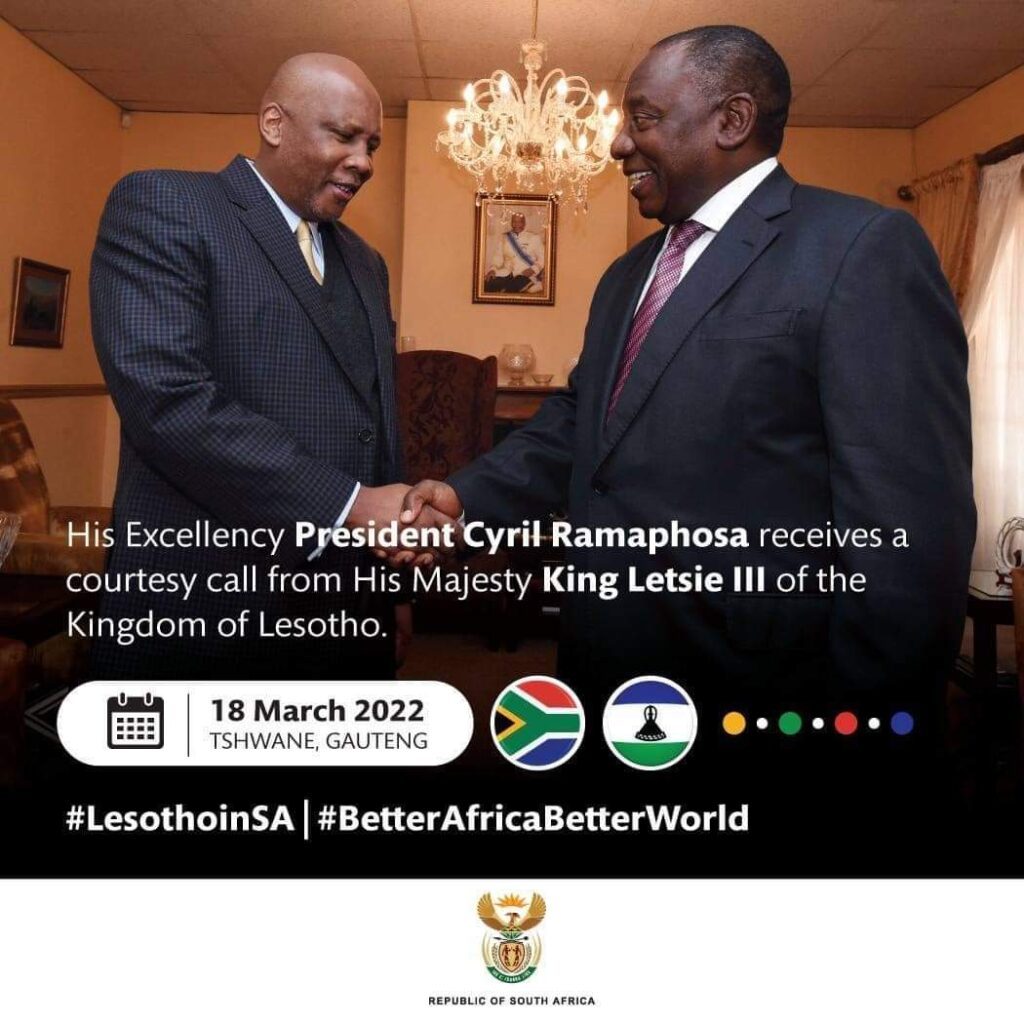
PRESIDENT RAMAPHOSA RECEIVED A COURTESY CALL FROM LESOTHO’S KING LETSIE III


17 March 2022

President Cyril Ramaphosa received a courtesy call from Lesotho’s King Letsie III at his official residence Mahlamba Ndlopfu in Pretoria, said the presidency

Acting presidency spokesperson Tyrone Seale said Ramaphosa received King Letsie III in his capacity as the Southern African Development Community (Sadc) facilitator to the Kingdom of Lesotho.

“The heads of state are exchanged views on bilateral relations and progress regarding the Sadc facilitation process in Lesotho,” Seale said in a statement.

Ramaphosa was appointed as facilitator in September 2014. Seale explained that after assuming the position of president in 2018, Ramaphosa appointed retired deputy chief justice Dikgang Moseneke to lead the Sadc facilitation team to Lesotho.

The Presidency

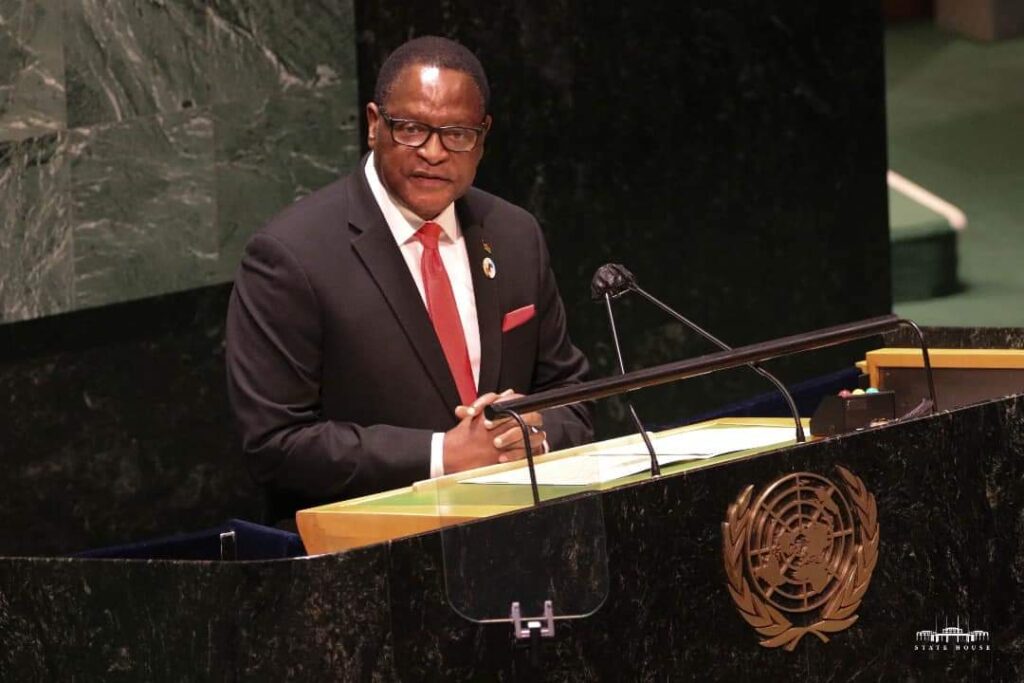
PRESIDENT DR LAZARUS CHAKWERA REMARKS BEFORE THE FIRST PART OF THE FIFTH UNITED NATIONS CONFERENCE ON LEAST DEVELOPED COUNTRIES

17 March 2021

I delivered my remarks before the first part of the fifth United Nations Conference on Least Developed Countries ( LDCs) on behalf of all the 46 members under this category.

My sentiments focused on reminding the United Nations to take special interest in addressing the needs of LDCs through concrete plans, investments and action.

I reminded the conference that poor societies and economies have faced more devastation from climate change, Covid-19 and economic uncertainties.

I also used the opportunity to specifically lobby Malawi’s case as critical in light of socioeconomic devastation over the past couple of years caused by the global pandemic, Cyclones Idai and Kenneth, Tropical Storms Ana and Gombe.

The conference has since adopted the Doha Programme of Action (DPoA) for 2022-2031 period. This is an intervention that seeks to chart a recovery path for LDCs and facilitate economic growth in line with the UN 2030 agenda for Sustainable Development Goals.

The DPoA will therefore support measures for eradicating poverty, ending hunger and malnutrition, making internet access universal, diversifying our economies and increasing our exports and trade. It will also set a benchmark for official development assistance.

Through the programme, there will be establishment of an online university, an international investment support center and food stockholding for enabling LDCs to build back stronger.

In addition, the programme launched the Sustainable Graduation Support Facility that will help economies move into upper brackets of development categories.

As LDCs we have also lobbied for debt relief and restructuring as one way to grant adequate cushion to our economies and help us recover meaningfully.

#SDGs
#UnitedNations
#LeastDevelopedCountries

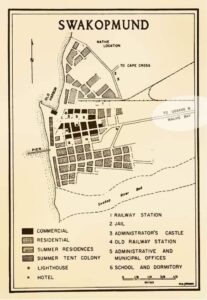
HISTORICAL

Excerpts from Prof. Richard F Logan
“The Central Namib of South West Africa” 1958
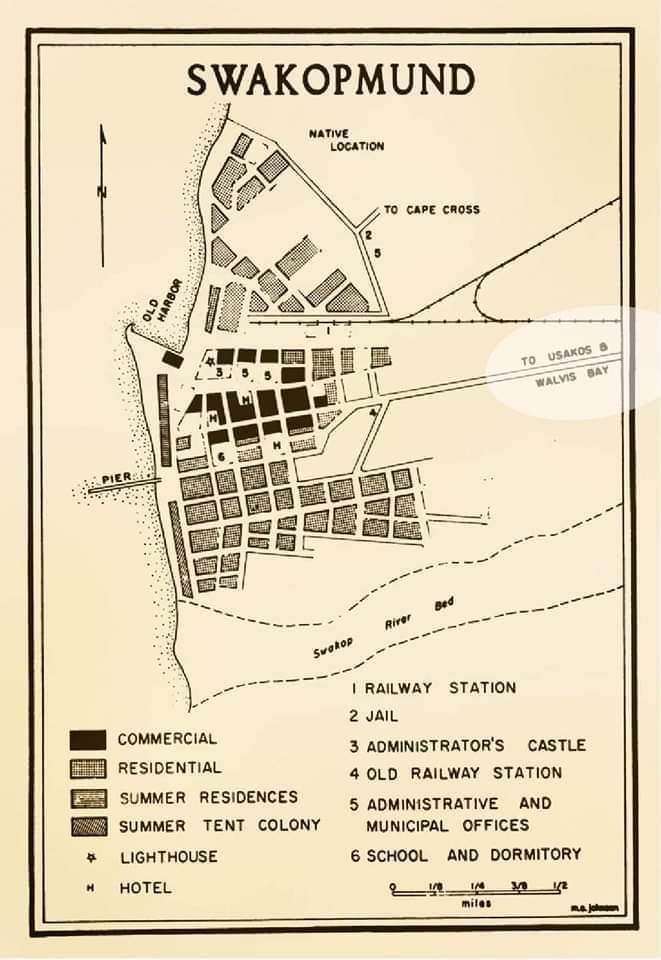
on Swakopmund

The town has water “laid on” (i.e. running water) supplied from a series of tube wells and bore holes in the bed of the Swakop River adjacent to the town. Its quality leaves something to be desired…… When used for showering it merely rearranged the patterns of dirt, and left the person washed even stickier than before. The local residents make coffee and tea with it; and grow so used to the taste that they sprinkle salt into coffee or tea made with ordinary water when visiting other towns.

To obtain a more potable water supply, the Municipality has an agreement with the Railways whereby a tank car of water is hauled from Walvis Bay on alternate days. This water is sold to the public on a cash and carry basis for a tickie (3 pennies) per gallon. In restaurants it is necessary to specify that one desires “Walvis tea” or “Walvis coffee” – otherwise the beverage will be made with salty local water.
On the alternate days the tank car is used to haul water for the local brewery which produces several forms of excellent German-type beer. The beer is shipped all over South West Africa – a curious export for a practically waterless town.

The town has the usual facilities providing most of the necessities of modern life: a number of stores and shops including up-to-date appliances, a good photo supply house, excellent jewelers and watchmakers, garages with first-class mechanics, gas stations and grocery stores, a butchery, a bakery and even a dairy.
The excellence and the quality of many services and amenities listed above can be attributed to the fact that the predominant ethnic group in Swakopmund is German. The town, like all of South West Africa, is officially bilingual (Afrikaans and English); but above all it is German. The German influence shows visibly in the architecture. The stucco buildings invariably have some feature imported from the old country; overhanging balconies, patches of half-timbering, curiously-shaped facades, ornate cornices, buildings surmounted by towers and turrets. The Administrator’s summer residence is a real castle (built for the German governor) and one of the school hostels (dormitories) has a tall watchtower (Kaserne). Some buildings have very steep roofs to shunt off the winter snows of Germany – in a land where snow has never fallen! The most ornate of buildings is the jail – so elaborate it is often mistaken for the Administrator’s castle.
….
The Swakopmund Aerodrome is located about 3 miles inland from the town, on the outer edge of a gravel terrace at an elevation of 250 feet. Its gravelly runway is 3100 feet long and oriented approximately east and west. There is no control, no lighting and no radio. There are three small hangars, privately owned, at the field. Upon request, South West Air Transport will extend its Windhoek-WalvisBay flight to pick-up or drop passengers at Swakopmund, but there is no regularly scheduled service. Planes arriving unexpectedly usually buzz the home and store of Hans Kriess, Swakopmund merchant, who sends out a refueling truck and a car to bring in passengers. ….

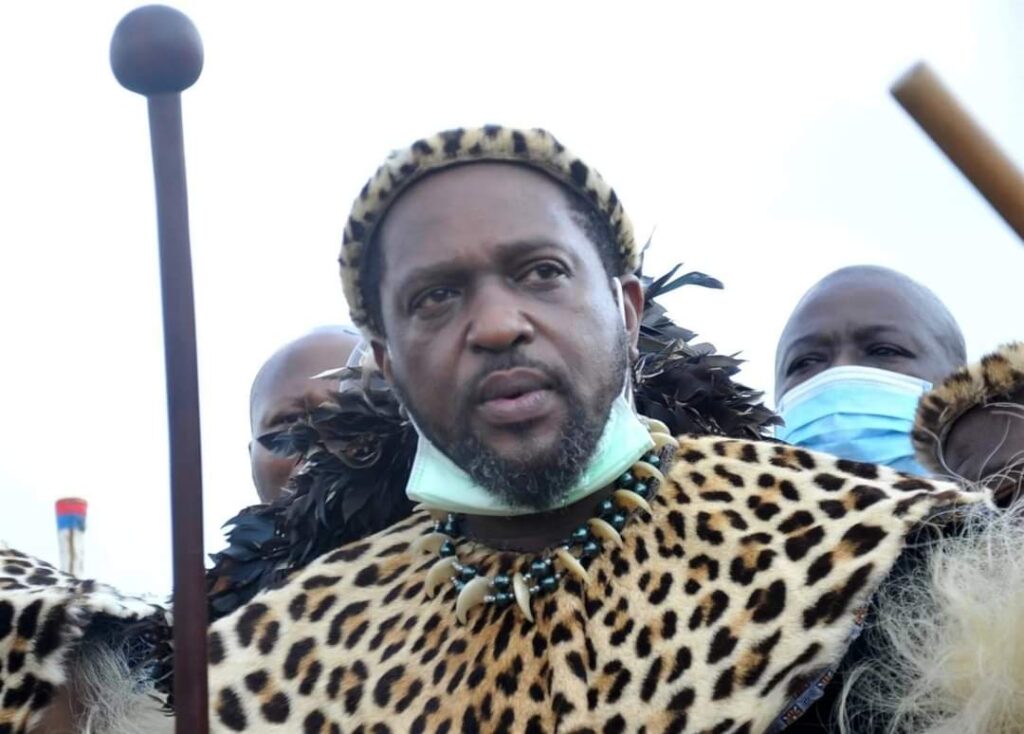
PRESIDENT RAMAPHOSA RECOGNISES PRINCE MISIZULU AS KING OF AMAZULU

16 March 2022

On Wednesday 16 March 2022 President Cyril Ramaphosa has, in terms of Section 8(3)(a) and (b) of the Traditional and Khoi-San Leadership Act, 2019, recognised King-Elect Prince Misuzulu Sinqobile Zulu as King of AmaZulu Kingship.

This follows the passing of His Majesty King Goodwill Zwelithini Zulu in March 2021 and the subsequent passing away of the Regent, Queen Mantfombi Dlamini, in April 2021.

In terms of the requirements of the Act, the Royal Family identified Prince Misuzulu Singqobile Zulu as the person who qualifies in terms of customary law and customs to assume the position of King and applied to the President for his recognition.

As required by the Act, the recognition of the King-Elect by the President follows consultations with the Minister of Cooperative Governance and Traditional Affairs and the Premier of KwaZulu-Natal.

President Ramaphosa conveys his warmest wishes to His Majesty King Misuzulu Zulu on the occasion of his legal recognition as King of AmaZulu Kingship.

President Ramaphosa said: “The assumption of the throne by His Majesty King Misuzulu Zulu is a moment of great significance in the proud and distinguished history of AmaZulu. His Majesty is the successor to a long line of revered monarchs, who fought with great courage and determination for the welfare and security of their people. I join all the people of South Africa in wishing His Majesty King Misuzulu Zulu a long and prosperous reign.”

HAPPY ST PATRICK’S DAY

17TH MARCH

St. Patrick was a 5th-century missionary to Ireland who is credited with bringing Christianity to Ireland. He became a legendary figure by the end of the 7th century and is considered a patron saint of Ireland.

Saint Patrick went from being sold into slavery to being credited to bringing Christianity to Ireland

“He had a dream that the Irish were crying for him that they needed him,” His return to Ireland and brought Christianity with him. He made the Celts and the pagans into Christians.”

St. Patrick’s Day is celebrated on March 17, the day he is assumed to have died. The holiday originally was tied to religious ideals but now is also a symbol of Irish pride.

Happy St. Patrick’s Day
#stpatricksday #Ireland

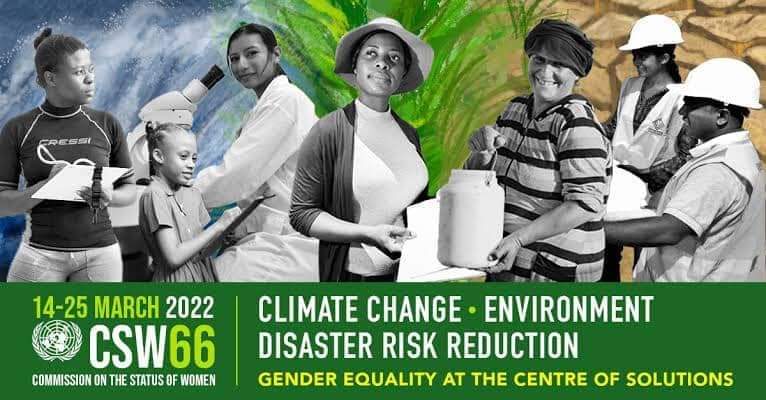
SOUTH AFRICA ASSUMES RESPONSIBILITY AS THE CHAIR OF THE 66TH SESSION OF THE COMMISSION ON THE STATUS OF WOMEN (CSW66)

16 March 2022

South Africa has assumed responsibility as the Chair of the 66th Session of the Commission on the Status of Women (CSW66) that is taking place at the United Nations (UN) Headquarters in New York from 14 – 25 March 2022.

The South African delegation is led by the Minister of Women, Youth and Persons with Disability, H.E. Ms M.E. Nkoana-Mashabane. Also in attendance are the Minister of Human Settlements, H.E. Ms M.T. Kubayi, and the Deputy Minister of Forestry, Fisheries and Environmental Affairs, H.E. Ms M. Sotyu.

The South African Permanent Representative to the UN, Ambassador Mathu Joyini, in her capacity as the Chair, opened the CSW66 on 14 March 2022, under the theme: “Achieving gender equality and the empowerment of all women and girls in the context of climate change, environmental and disaster risk reduction policies and programmes”.

South Africa is chairing the CSW at a time when the government has taken a deliberate policy decision to give highest priority to the thematic issues of women, children and persons with disabilities as they have historically suffered multiple and aggregated forms of discrimination.

South Africa has consistently been the champion and advocate for the UN programmes to initiate concrete and tangible empowerment programmes for the realisation of the rights of these categories.

The delegation will also present South Africa’s report on the implementation of the 61st session Agreed Conclusions on the review theme titled “Women’s economic empowerment in the changing world of work”.

📸 unwomen.org

PRESIDENT OF THE REPUBLIC OF KAZAKHSTAN, HIS EXCELLENCY KASSYM-JOMART TOKAYEV DELIVERED STATE-OF-THE-NATION ADDRESS TO THE PEOPLE OF KAZAKHSTAN

16 March 2022

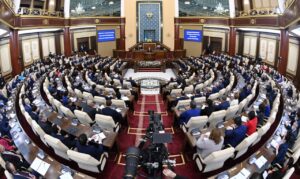
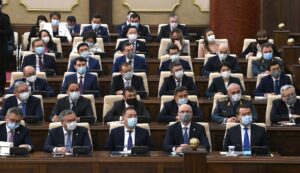
The President delivered a State-of-the-Nation Address to the people of Kazakhstan “New Kazakhstan: Path of Renewal and Modernization” at the joint session of the Houses of Parliament.

The leader of Kazakhstan unveiled a large-scale program of political reforms and a number of socio-economic measures to be implemented in the near future.

At the beginning of his speech, President Tokayev voiced his view on the tragic events of January. In his opinion, the goal of this large-scale and elaborate operation was to oust the nation’s top political leadership and discredit it in the eyes of the people and the foreign public.

The President said the investigation of the conspiracy of law enforcement officers and their accomplices continues at an intensive pace, in secrecy, and all those found guilty of these tragic events will be punished, regardless of their positions and ranks in society.

Kassym-Jomart Tokayev pointed out the importance of revising the powers of the President with a transition from a super-presidential system to a presidential republic with a strong Parliament. In particular, it was proposed to legislate the commitment of the Head of State to terminate membership in the party for the period of his powers, and to prohibit Akims and their deputies to hold positions in the party branches.

In addition, the leader of Kazakhstan announced the necessity to constitutionally fix a norm concerning the nearest relatives of the Head of State. A legislative ban was proposed on their appointment as top-level civil servants and managers in the quasi-state sector.

Furthermore, political reforms will affect the legislative branch of power. The process of formation and a number of functions of the Senate will be revised. Kazakhstan’s leader proposed reducing the presidential quota in the upper house of the Parliament (the Senate) from 15 to 10 deputies. Moreover, the quota of the Assembly of the People of Kazakhstan in the Mazhilis will be transferred to the Senate and reduced from 9 to 5 deputies.

The program of political reforms also provides for the improvement of the electoral system, modernization of the electoral process, and expansion of opportunities for development of the party system. The deputies’ corps of the Mazhilis will be formed on a mixed scheme – 70% of deputies will be elected on a proportional basis, 30% – on a majoritarian one. Party registration procedures will be considerably simplified. The registration threshold is to be reduced fourfold – from 20,000 to 5,000 people.

President Tokayev also focused on strengthening the role of human rights institutions, increasing the competitiveness of the media and strengthening the role of civil society institutions. In order to ensure that the provisions of the Basic Law are strictly observed, he instructed to create a Constitutional Court. The President also proposed the establishment of a National Kurultai to replace the National Council of Public Trust, which has successfully fulfilled its mission.

Large-scale political reforms will also be made in the administrative-territorial structure of the country. Kazakhstan’s leader proposed the creation of Abai and Ulytau regions, with their regional centers in the cities of Semey and Zhezkazgan, respectively. He also announced his decision to divide the Almaty region into two new ones: the Almaty region centered in Kapshagai and the Zhetysu region centered in Taldykorgan. The Head of State said he was ready to listen to public opinion, if there is a proposal to rename the city of Kapshagai in honor of an outstanding son of the Kazakh people, Dinmukhamed Kunayev.

A separate part of the Address was devoted to the priority of anti-crisis measures with a focus on tackling socio-economic issues, including ensuring the stability of the national currency, increasing the sales of foreign exchange earnings by companies with state participation, and de-bureaucratization of the state apparatus.

Overall, the initiatives announced in President Tokayev’s Address to the Nation are aimed at significant transformation of the political system and administrative-territorial structure of the country. According to him, more than 30 amendments will be made to the Constitution for their implementation.

“Regardless of how people evaluate my work, my most important duty is to protect our country. On this path, I am ready to bear full responsibility!” the Kazakhstan’s leader concluded.

The President of the Republic of Kazakhstan
State of the nation address
The Republic of Kazakhstan, Nur-Sultan, Presidential Palace

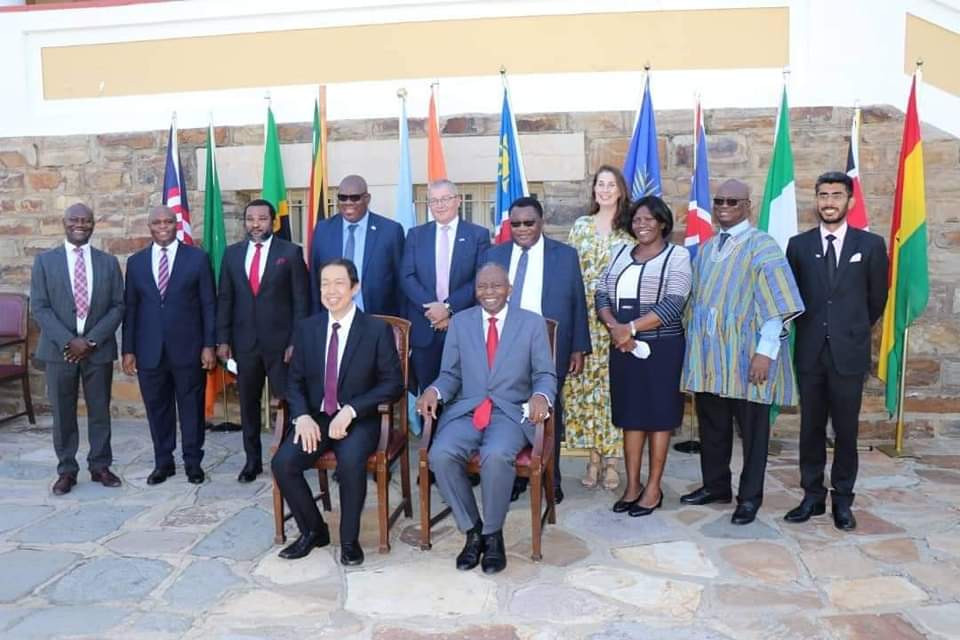
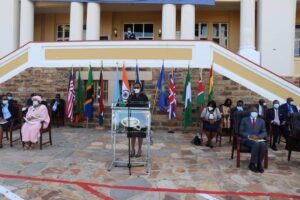
NAMIBIA COMMEMORATED COMMONWEALTH DAY AT AN EVENT HELD AT THE PARLIAMENT BUILDING IN WINDHOEK

 14 March 2022

The commemoration was held under the theme for the forthcoming Commonwealth Heads of Government Meeting “Delivering a Common Future: Connecting, Innovating, Transforming” which is scheduled to take place in June 2022.

The theme highlights how the 54 member states in the Commonwealth family are “innovating, connecting and transforming” to help achieve goals like fighting climate change, promoting good governance and boosting trade.

Ms. Nomsa Uushona, Deputy Director of International Organizations in the Ministry of International Relations and Cooperation; in the closing remarks read on behalf of the Ministry noted that the event was a productive gathering, which brought together the Commonwealth family.

“Namibia is undeniably honoured to have this event commemorated this year, and on behalf of the Government of the Republic of Namibia, I wish to extend our profound gratitude and appreciation to the Commonwealth countries represented in Namibia and to all representatives for taking out time out from their busy schedules to participate in this event,” she said.

Ms. Uushona concluded her remarks by stating that Commonwealth member states, should continue to focus on issues of shared interest within the Commonwealth, such as the Post COVID-19 recovery, vaccine equity, climate change, poverty eradication and sustainable development among others.

“A Commonwealth that shows prosperity for all its members is a Commonwealth that will be happy and can push in the same direction of a sustainable path,” she concluded. South Africa also joined the other Commonwealth member states in marking Commonwealth Day today 14 March 2022, under the theme: “Delivering a Common Future: Connecting, Innovating, Transforming.”

54 countries on six different continents, are joined in pursuing their common goals to promote a fairer, prosperous, sustainable, and secure future, in line with the United Nations’ 2030 Agenda on Sustainable Development.

South Africa cooperates with the Commonwealth in the fields of economic development, trade and investment, education and skills development, women and youth empowerment, technology and innovation, as well as the blue economy.

“South Africa will continue to work closely with the Commonwealth, to build a common and inclusive future, especially in the aftermath of COVID-19. On Commonwealth Day, South Africa again renews its pledge to uphold and serve the values and fellowship of the Commonwealth,” said Minister Pandor.