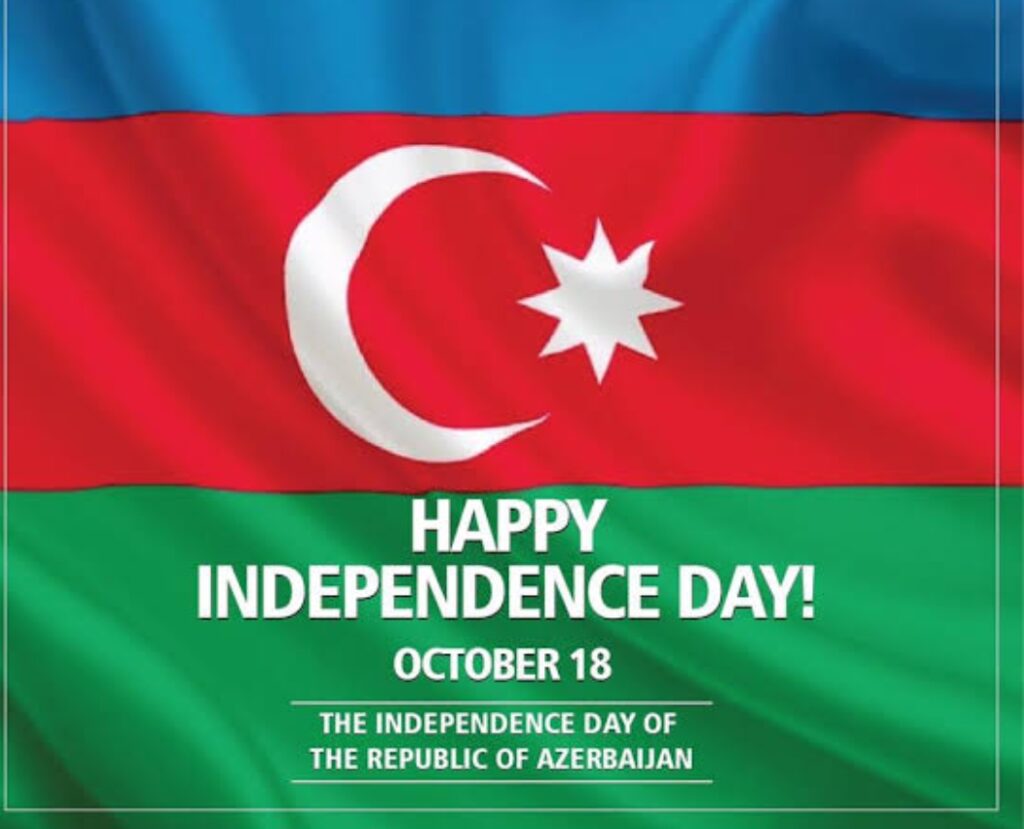
AZERBAIJAN MARKS 30 YEARS SINCE RESTORATION OF INDEPENDENCE

The Diplomatic Informer Magazine would like to congratulate the Government and the people of Azerbaijan as they celebrate the Day of the Restoration of Independence on October 18, 2021 marking a special milestone, commemorating the 30th anniversary of restored Azerbaijani independence.

The Independence Day of Azerbaijan is the main state holiday in Azerbaijan. It is celebrated annually on October 18. On this day in 1991, the Supreme Soviet of Azerbaijan adopted a Constitutional Act on the Declaration of Independence of Azerbaijan. The declaration was confirmed by a referendum in December 1991.

It has been 30 years since Azerbaijan restored the country’s independence on October 18, 1991 with the Constitutional Act of State Independence of Azerbaijan – an event that ended more than seven decades of Soviet rule.

The occasion has been celebrated as Independence Day for 29 years since 1991. However, President Ilham Aliyev signed a decree on October 15, 2021, to rename it as the Day of Restoration of Independence.

The Constitutional Act of State Independence of Azerbaijan ushered in the rebirth of the statehood founded by the Azerbaijan Democratic Republic (ADR) in 1918. The document announced Republic of Azerbaijan as the successor of ADR, which had a brief life in the early part of the 20th century.

Established on May 28, 1918, in the wake of the Russian Empire’s collapse, the ADR was the first democratic republic in the Muslim world that granted women equal voting rights with men. However, the Bolsheviks could not tolerate ADR’s sovereignty, took over the country forcibly on April 28, 1920, and later incorporated Azerbaijan into the Soviet Union.

After 71 years of Soviet rule, Azerbaijan’s Supreme Council adopted the Constitutional Act of State Independence of Azerbaijan on October 18, 1991. The historical document referred to the Declaration of Independence adopted on May 28, 1918, and the “On the Restoration of State Independence of the Republic of Azerbaijan” declaration endorsed by the Supreme Soviet of Azerbaijan on August 30, 1991.

AU CHAMPION FOR COVID-19 RESPONSE TO REPORT BACK AT 3rd AU MID-YEAR COORDINATING MEETING

The African Union Champion for COVID-19 Response His Excellency President Cyril Ramaphosa will on Saturday, 16 October 2021, participate in the 3rd Mid-Year Coordination Meeting between the African Union, Regional Economic Communities and Regional Mechanisms.

President Ramaphosa will report on the progress of the continent’s response to the pandemic in his capacity as the African Union COVID-19 Champion.

The meeting will proceed virtually from 11:00 South African Time with an opening ceremony to be addressed by African Union Chairperson, His Excellency Félix Antoine Tshisekedi Tshilombo, President of the Democratic Republic of Congo, and Chairperson of the African Union Commission, His Excellency Moussa Faki Mahamat.

The meeting of the African Union, Regional Economic Communities and Regional Mechanisms derived its mandate from the 28th AU Heads of State and Government Ordinary Session of the Assembly in 2017. The Assembly identified the underlying need for a clear division of labour and effective collaboration between member states and continental organisations to achieve the aspirations of Agenda 2063.

The Heads of State and Government will at the 3rd Coordination Meeting deliberate on the following:

• Consideration of the Report on the Status of the Regional Integration in Africa;

• Consideration of the Report on the Division of Labour between the Member States;

• African Union Commission and the Regional Economic Communities;

• Progress Report on the COVID-19 Pandemic on the Continent;

• Provisional appointment of the Chief Executive Officer of the AUDA-NEPAD;

• Consideration and Adoption of the Draft Declaration for the 3rd Mid-Year Coordination Meeting.

There are currently eight AU regional economic communities and two regional mechanisms on the continent, namely:

1) Arab Maghreb Union (AMU);

2) the Common Market for Eastern and Southern Africa (COMESA);

3) the Community of the Sahel-Saharan States (CEN-SAD);

4) the East African Community (EAC);

5) the Economic Community of Central African States (ECCAS);

6) the Economic Community of West African States (ECOWAS);

7) the Intergovernmental Authority on Development (IGAD); and

8.) the Southern African Development Community (SADC).

The regional mechanisms are the North Africa Regional Capability (NARC) and the East African Standby Force Coordination Mechanism (EASFCOM).

The Opening Ceremony of the 3rd AU Midyear Coordinating meeting can be followed on Presidency and government digital platforms.

European Film Festival in South Africa14 – 24

 October 2021

The 8th edition of the European Film Festival in South Africa will present a select curation of 18 top new films from Europe.

With South Africa still facing a lot of uncertainty around COVID and following the success of last year’s online festival, the 8th edition will again be predominantly a virtual event. Please diarise the dates and join us for some excellent films free of charge!

2021 Film Selection

BOOK NOW!

Bringing the best of European film to South Africa’s home screens, the European Film Festival 2021 is a partnership project of the Delegation of the European Union to South Africa and 17 European embassies and cultural agencies in South Africa: the Embassies of Austria, Belgium, Czech Republic, Denmark, Ireland, Italy, Lithuania, the Netherlands, Poland, Portugal, Spain, Sweden, Switzerland, Ukraine, and the British Council, Camoes Institute of Portugal, Diplomatic Representation of Flanders, French Institute in South Africa, Goethe-Institut, and Italian Cultural Institute. The festival is organised in cooperation with Cineuropa and coordinated by Creative WorkZone.

SA WELCOMES NEW HIGH COMMISSIONERS AND AMBASSADORS

13 October 2021

His Excellency President Matamela Cyril Ramaphosa received Letters of Credence from Heads of Mission Designate accredited to the Republic of South Africa.

The diplomats from 15 countries from across Europe, Asia, North and South America and Africa and were appointed by their respective countries to serve as Ambassadors and High Commissioners to the Republic of South Africa.

While meeting the President, the diplomats took the opportunity to commit to strengthening ties between South Africa and their respective countries.

South Africa’s biggest trading partners on the African continent, outside of Southern and East Africa, Nigeria and Ghana also presented their credentials to the President on Tuesday.

New Ghanaian High Commissioner, Charles Owiredu reflected on the two countries’ shared past going back to the apartheid era.

“We in Ghana are happy to learn that yourself and [Ghanaian President] Nana Akufo-Addo, have escalated our Joint Commission to the level of a Bi-National Commission…this will further strengthen the relationship in terms of trade and investment and also, the people to people contact,” Owiredu said.

Incoming Nigerian High Commissioner Haruna Manta said his presence in the country would be to deepen exchanges in education, military training and other areas.

“I’m here to build on the solid foundation laid by my predecessors…to promote trade between our two countries and to also promote our cultural exchanges,” he said.

Two of South Africa’s biggest international trade partners, Germany and the United Kingdom also committed to reinforcing bonds.

The new German Ambassador Andreas Peschke said that President Ramaphosa’s recent visit to Germany underlined the importance of the ties between the two countries, which would be strengthened moving forward.

“Among the priorities for me by my government…are the following, first [is to] enhance the economic relationship between our countries by increasing the level of trade and investment. Second, [is to] cooperate in the field of skills development and education, third, cooperation in the area of health and particularly in the area of vaccines against COVID-19 and others and fourth, cooperation on a fair, just and green energy transition,” Peschke said.

Incoming United Kingdom of Great Britain and Northern Ireland High Commissioner Antony Phillipson, who was born in South Africa, described links between the two countries as “deep and enduring ties”.

“Our aim is to strengthen this partnership through more trade and investment, enhancing bilateral engagements with a focus on inclusive economic growth and creating opportunities for all. That includes forging new links in areas like science and research.

“We must also stand together to face global challenges. The most immediate of course is COVID. As we tackle it nationally, we must work together in the G7, the G20, the Commonwealth and elsewhere,” he said.

The following Heads of Mission presented their Credentials:-

Republic of Bulgaria 🇧🇬 – Ms Maria Pavlova Tzotzorkova-Kaymaktchieva

Republic of Ghana 🇬🇭 – Mr Charles Asuako Owiredu

Oriental Republic of Uruguay 🇺🇾 – Mr Jose Luis Rivas Lopez

Republic of Seychelles 🇸🇨 – Mr Claude Morel

Republic of Burundi 🇧🇮 – Mr Alexis Bukuru

Republic of Turkey 🇹🇷 – Ms Ayşegül Kandaş

Republic of Sierra Leone 🇸🇱 – Mr Adekunle Joliff Milton King

United Kingdom of Great Britain 🇬🇧  – Mr Antony John Phillipson

Federal Republic of Nigeria 🇳🇬 – Mr Haruna Manta

Republic of Maldives 🇲🇻 – Mr Omar Abdul Razzak

Dominican Republic 🇩🇴 – Mr Reymundo Antonio Garrido Lantigua

Canada 🇨🇦 – Mr Christopher Cooter

Federal Republic of Germany 🇩🇪 – Mr Andreas Peschke

Republic of Singapore 🇸🇬 – Mr Zainal Arif Mantaha

Republic of Djibouti 🇩🇯 – Mr Yacin Elmi Bouh

Republic of Cyprus 🇨🇾 – Mr Antonis Mandritis

The Diplomatic Informer Magazine SA, welcomes the new Heads of Missions and wishes them the best during their tour of duty in the Republic of South Africa.

Photos: Dirco and GCIS Source: Presidency, Dirco and GCIS

MINISTER PANDOR  HOSTED HE DR RIAD MALKI, MINISTER OF FOREIGN AFFAIRS AND EXPATRIATES OF THE STATE OF PALESTINE  ON AN OFFICIAL VISIT FROM 7 TO 9 OCTOBER 2021

The Minister of International Relations and Cooperation, Dr Naledi Pandor, will hosted the Minister of Foreign Affairs and Expatriates of the State of Palestine, Dr Riad Malki, during an official visit to South Africa from 7 – 9 October 2021.

On Friday, 08 October 2021, the two Ministers hold bilateral talks at the Department of International Relations and Cooperation

South Africa attaches great importance to its relationship with Palestine, which is underpinned by historic bonds of solidarity, friendship and cooperation. South Africa’s support for the Palestinian cause conforms with the basic tenets of its foreign policy.

The visit takes place as the Palestinian people continue to be subjected to countless injustices and an ongoing cycle of destruction, displacement, and dispossession, as well as the progressive fragmentation of its territory.

The international community has an obligation to find a comprehensive and just resolution to the Palestinian issue. South Africa calls for international support and increased efforts for the just cause of the Palestinian people to address their legitimate demand for an independent state alongside a peaceful state of Israel.

The visit aimed at further strengthening the relationship between South Africa and Palestine- to provide political support, enhance coordination and cooperation and maintain high-level exchanges, to advance bilateral cooperation in the identified areas.

South Africa stands ready to work more closely with Palestine and the meeting  endorsed the strong solidarity of both countries and their belief in multilateralism and the centrality of the United Nations, including the Security Council, as essential in promoting effective and inclusive international cooperation in resolving a variety of current global challenges, including the peaceful settlement of conflicts.

CONGRATULATIONS TO 2021 NOBEL PEACE WINNERS MARIA RESSA AND DMITRY MURATOV:

Congratulations to Maria Ressa and Dmitry Muratov! Thank you for your courageous fight for freedom of expression, vital to democracy & peaceful societies.

Journalists Maria Ressa and Dmitry Muratov have been awarded the Nobel Peace Prize for their fights to defend freedom of expression in the Philippines and Russia.

Both are known for investigations that have angered their countries’ rulers and both have faced threats as a result of this.

BBC journalists who have worked with the pair shared their experiences.

Dmitry Muratov is a complex and at times contradictory personality. Over the years of working together, I have seen him bitterly argue with his best correspondents one day, and the next rescue them from an extremely dangerous situation while they were covering a story.

Dmitry’s contribution to the development of journalism in Russia cannot be underestimated. He created a unique team of journalists at an organisation that has been considered the main independent media in Russia for some time.

Journalists Maria Ressa and Dmitry Muratov have been awarded the Nobel Peace Prize for their fights to defend freedom of expression in the Philippines and Russia.

Both are known for investigations that have angered their countries’ rulers and both have faced threats as a result of this.

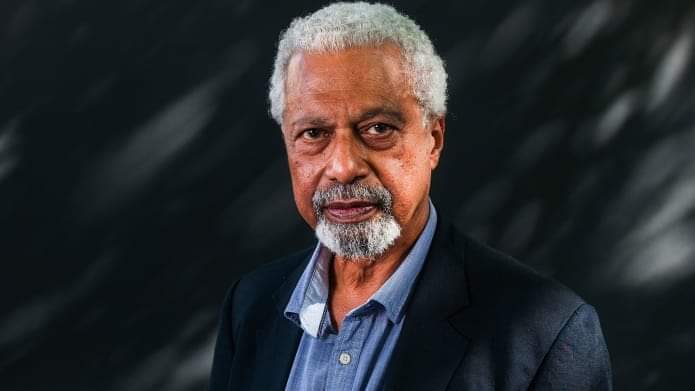
CONGRATULATIONS TO AFRICA FOR THE AWARDING OF TANZANIAN NOVELIST ABDULRAZAK GURNAH THE 2021 NOBEL PRIZE IN LITERATURE

8 October 2021

A great achievement for the African continent that demonstrates the huge potential Africa has to offer. Thank you,  Mr. Gurnah, for making Africa proud!

Abdulrazak Gurnah was born in 1948 and grew up on the island of Zanzibar in the Indian Ocean but arrived in England as a refugee in the end of the 1960s. After the peaceful liberation from British colonial rule in December 1963 Zanzibar went through a revolution which, under President Abeid Karume’s regime, led to oppression and persecution of citizens of Arab origin; massacres occurred. Gurnah belonged to the victimised ethnic group and after finishing school was forced to leave his family and flee the country, by then the newly formed Republic of Tanzania. He was eighteen years old. Not until 1984 was it possible for him to return to Zanzibar, allowing him to see his father shortly before the father’s death. Gurnah has until his recent retirement been Professor of English and Postcolonial Literatures at the University of Kent in Canterbury, focusing principally on writers such as Wole Soyinka, Ngũgĩ wa Thiong’o and Salman Rushdie.

Gurnah has published ten novels and a number of short stories. The theme of the refugee’s disruption runs throughout his work. He began writing as a 21-year-old in English exile, and even though Swahili was his first language, English became his literary tool. He has said that in Zanzibar, his access to literature in Swahili was virtually nil and his earliest writing could not strictly be counted as literature. Arabic and Persian poetry, especially The Arabian Nights, were an early and significant wellspring for him, as were the Quran’s surahs. But the English-language tradition, from Shakespeare to V. S. Naipaul, would especially mark his work. That said, it must be stressed that he consciously breaks with convention, upending the colonial perspective to highlight that of the indigenous populations. Thus, his novel Desertion (2005) about a love affair becomes a blunt contradiction to what he has called “the imperial romance”, where a conventionally European hero returns home from romantic escapades abroad, upon which the story reaches its inevitable, tragic resolution. In Gurnah, the tale continues on African soil and never actually ends.

In all his work, Gurnah has striven to avoid the ubiquitous nostalgia for a more pristine pre-colonial Africa. His own background is a culturally diversified island in the Indian Ocean, with a history of slave trade and various forms of oppression under a number of colonial powers – Portuguese, Arab, German and British – and with trade connections with the entire world. Zanzibar was a cosmopolitan society before globalisation.

Gurnah’s writing is from his time in exile but pertains to his relationship with the place he had left, which means that memory is of vital importance for the genesis of his work. His debut novel, Memory of Departure, from 1987, is about a failed uprising and keeps us on the African continent. The gifted young protagonist attempts to disengage from the social blight of the coast, hoping to be taken under the wing of a prosperous uncle in Nairobi. Instead he is humiliated and returned to his broken family, the alcoholic and violent father and a sister forced into prostitution.

In the second work, Pilgrims Way from 1988, Gurnah explores the multifaceted reality of life in exile. The protagonist, Daud, is confronted with the racist climate of his new homeland, England. After having tried to hide his past, love for a woman entices Daud to tell his story. He can then recount what happened in his tragic upbringing and the traumatic memories of the political turmoil in Tanzania that forced him into flight. The novel ends with Daud’s visit to Canterbury cathedral where he meditates on the parallels between the Christian pilgrims who visited the place in past times and his own journey to England. He had previously defiantly resisted everything the former colonial power had exulted over, but suddenly, beauty was attainable. The novel shapes into a secular version of a classic pilgrimage, using historical and literary antecedents as interlocutors in issues of identity, memory and kinship.

Gurnah often allows his carefully constructed narratives to lead up to a hard-won insight. A good example is the third novel, Dottie (1990), a portrait of a Black woman of immigrant background growing up in harsh conditions in racially charged 1950’s England, and because of her mother’s silence lacking connection with her own family history. At the same time, she feels rootless in England, the country she was born and grew up in. The novel’s protagonist attempts to create her own space and identity through books and stories; reading gives her a chance to reconstruct herself. Not least names and name changes play a central role in a novel that shows Gurnah’s deep compassion and psychological adroitness, completely without sentimentality.

Gurnah’s fourth novel, Paradise (1994), his breakthrough as a writer, evolved from a research trip to East Africa around 1990. The novel has obvious reference to Joseph Conrad in its portrayal of the innocent young hero Yusuf’s journey to the heart of darkness. But it is also a coming of age account and a sad love story in which different worlds and belief systems collide. We are given a retelling of the Quran’s story of Joseph, against the background of a violent and detailed description of the colonisation of East Africa in the late 19th century. In a reversal of the Quran story’s optimistic ending, where Joseph is rewarded for the strength of his faith, Gurnah’s Yusuf feels forced to abandon Amina, the woman he loves, to join the German army he had previously despised. It is characteristic of Gurnah to frustrate the reader’s expectations of a happy ending, or an ending conforming to genre.

In Gurnah’s treatment of the refugee experience, focus is on identity and self-image, apparent not least in Admiring Silence (1996) and By the Sea (2001). In both these first-person novels silence is presented as the refugee’s strategy to shield his identity from racism and prejudice, but also as a means of avoiding a collision between past and present, producing disappointment and disastrous self-deception. In the first of these two novels, the prejudiced narrator choses to hide his past from his English family and invent a life story better suited to their commonly constructed world. But it is a twinned silence since he is also hiding his life in exile from his family in Zanzibar, who are unaware that he has a new family in England and a seventeen-year-old daughter. In By the Sea, another drama of disappointment and self-deception ensues. Saleh, the narrator of the first part, is an old Muslim from Zanzibar applying for asylum in England with a visa forged in the name of a bitter enemy. When he meets the enemy’s son, Latif, the narrator of the book’s second part, it is only because Latif has coincidentally been delegated to help Saleh adjust to his new home country. In their impassioned quarrels, Saleh’s suppressed past in Zanzibar rears up within him. But where Saleh despite all tries to remember, Latif does everything to forget. It creates a peculiar tension in the novel, where the choice of two narrators dissolves the fiction’s plotted path and direction, as well as the narrators’ authority and self-perception.

Gurnah’s itinerant characters find themselves in a hiatus between cultures and continents, between a life that was and a life emerging; it is an insecure state that can never be resolved. We find a new version of this hiatus in Gurnah’s above-mentioned seventh novel, Desertion, where a tragic passion is employed to illuminate the vast cultural differences in colonised East Africa. The long first part is masterfully forged. Set around the turn of the 20th century it describes how Englishman Martin Pearce, collapsing unconscious in the street, is helped by a local merchant and taken through the city’s labyrinths into a world where the culture and religion are alien. But Pearce speaks Arabic, one of the preconditions for closer contact with the family and for him to fall in love with their daughter Rehana. Gurnah knows full well that the era he is portraying is not, as said in the novel, “the age of Pocahontas when a romantic fling with a savage princess could be described as an adventure” and is uninterested in a melodrama about Martin and Rehana’s scandalous life in Mombasa with inevitable separation as a consequence. Instead, he lets the subsequent parts of the novel revolve around a completely different story of forbidden love a half-century later, but just as marked by the cultural barriers that endure. Perhaps nowhere else does Gurnah so clearly articulate his mission as a writer than in the end of the first section, in a meta-fictitious “interruption”, where the grandson of Rehana, surfaces as the narrator of the novel. He is, by his existence, proof that Rehana’s life did not end in catastrophe but had a continuation, and he now says that the story is not about him: “It is about how one story contains many and how they belong not to us but are part of the random currents of our time, and about how stories capture us and entangle us for all time.”

Underpinning the novel is Gurnah’s own youth in Zanzibar, where for centuries a number of different languages, cultures and religions have existed side by side but also fought each other for hegemony. Even if his novels are written in an intriguing alliance with an Anglo-Saxon tradition, the cosmopolitan backdrop provides their distinctiveness. Dialogue and the spoken word play an important role, with noticeable elements of Swahili, Arabic, Hindi and German.

The Last Gift, from 2011, relates thematically to Pilgrims Way and ends with something of the same bitter brew when the ailing refugee Abbas dies and bequeaths the gift of the book’s title, consisting of a tape recording of a cruel history unknown to the surviving family.

In Gravel Heart (2017) Gurnah further develops his theme of a young person’s confrontation with evil and uncomprehending surroundings. This exciting and austerely recounted first-person narrative depicts the fate of the young Salim up until the conclusion’s terrifying revelation of a family secret kept from him but decisive for his entire trajectory as a rootless individual in exile. The book’s first sentence is a brutal declaration: “My father did not want me.” The title is a reference to Shakespeare’s drama Measure for Measure and the Duke’s words in the third scene of the fourth act: “Unfit to live or die! O gravel heart.” It is this double incapability that has become Salim’s fate.

Gurnah’s latest novel, the magnificent Afterlives from 2020, takes up where Paradise ends. And as in that work, the setting is the beginning of the 20th century, a time before the end of German colonisation of East Africa in 1919. Hamza, a youth reminiscent of Yusuf in Paradise, is forced to go to war on the Germans’ side and becomes dependent on an officer who sexually exploits him. He is wounded in an internal clash between German soldiers and is left at a field hospital for care. But when he returns to his birthplace on the coast he finds neither family nor friends. History’s capricious winds rule and as in Desertion we follow the plot through several generations, up until the Nazis’ unrealised plan for the recolonisation of East Africa. Gurnah again uses name-changing when the story shifts course and Hamza’s son Ilias becomes Elias under German rule. The denouement is shocking and as unexpected as it is alarming. But in fact the same thought recurs constantly in the book: the individual is defenceless if the reigning ideology – here, racism – demands submission and sacrifice.

Gurnah’s dedication to truth and his aversion to simplification are striking. This can make him bleak and uncompromising, at the same time as he follows the fates of individuals with great compassion and unbending commitment. His novels recoil from stereotypical descriptions and open our gaze to a culturally diversified East Africa unfamiliar to many in other parts of the world. In Gurnah’s literary universe, everything is shifting – memories, names, identities. This is probably because his project cannot reach completion in any definitive sense. An unending exploration driven by intellectual passion is present in all his books, and equally prominent now, in Afterlives, as when he began writing as a 21-year-old refugee.

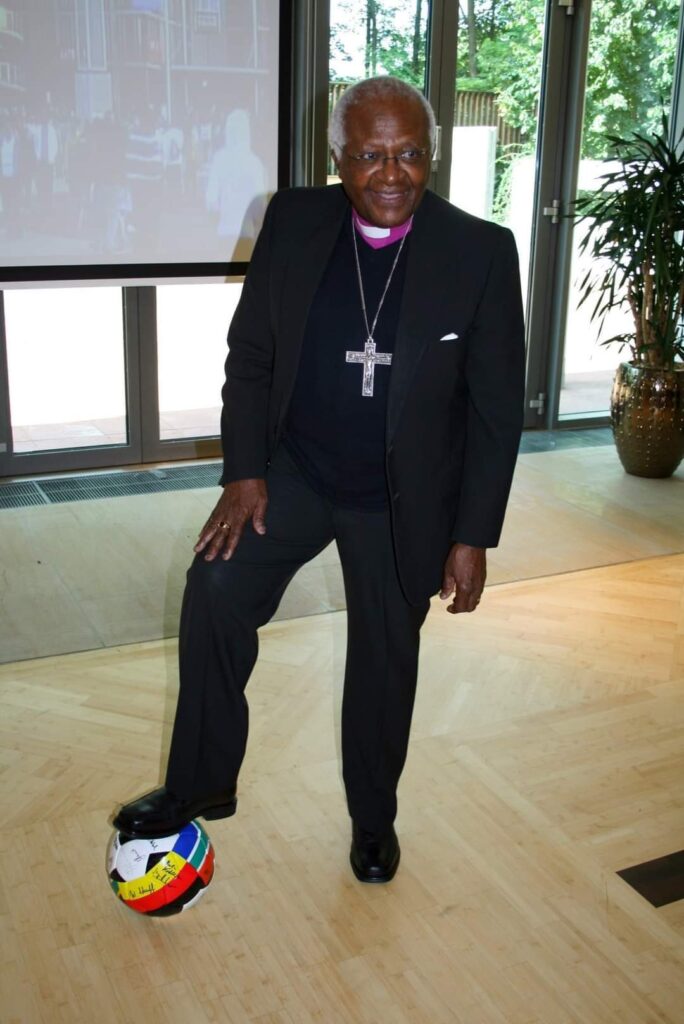
STATEMENT BY PRESIDENT JOSEPH R. BIDEN, JR. ON THE OCCASION OF ARCHBISHOP DESMOND TUTU’S BIRTHDAY

October 07, 2021

I send my best wishes to Archbishop Desmond Tutu on his 90th birthday and join the world in celebrating his life of service and contributions to humanity. I’ve been honored to meet and spend time with Archbishop Tutu on several occasions over the years, and like so many others, I am inspired by his personal commitment to championing human rights and to always speaking out for what is right. The world first came to know Archbishop Tutu as he modeled the highest tenets of his faith in challenging the injustice of Apartheid in South Africa. His courage and moral clarity at that time helped inspire my own commitment as a United States Senator to change American policy toward the Apartheid regime in South Africa. And in the years since, the world has continued to learn from Archbishop Tutu’s message of justice, equality, and reconciliation.

In honor of Archbishop Tutu, let us all recommit ourselves to the work that has animated his life: advancing respect for human rights, strengthening equality, protecting fundamental freedoms, and fighting for racial justice, both at home and around the world.

The White House Statement

DEPUTY MINISTER CANDITH MASHEGO-DLAMINI HOSTED HER COUNTER PART THE SECRETARY-GENERAL OF THE MINISTRY OF FOREIGN AFFAIRS OF THE STATE OF QATAR, DR AHMED HASSEN AL-HAMMADI

 07/10/2021.

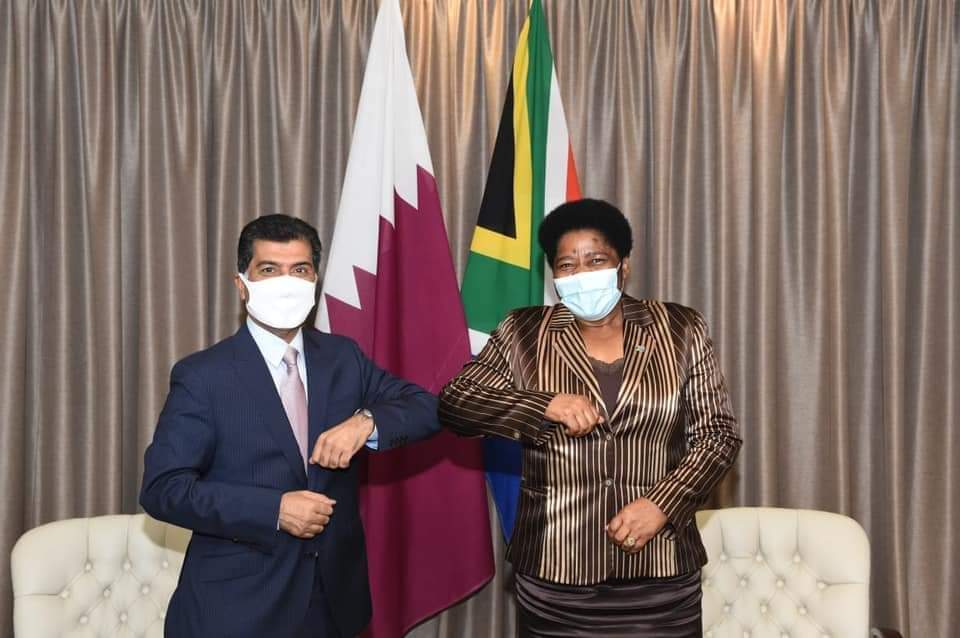
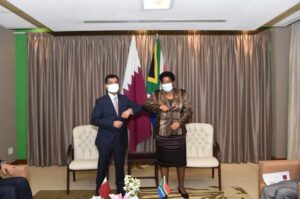
The Deputy Minister of the Department of International Relations and Cooperation, Ms Candith Mashego-Dlamini, hosted her Qatari Counterpart, Dr Ahmed Hassen Al-Hammadi, Secretary-General of the Ministry of Foreign Affairs of the State of Qatar, on Thursday, 7 October 2021 in Pretoria.

During the meeting, areas of mutual interest were discussed, as well as the strengthening of bilateral political and economic relations. The meeting took place in the greater context of preparing for the South Africa-Qatar Bilateral Consultations that are scheduled to be held at Ministerial level in 2022.

The discussions between Deputy Minister Mashego-Dlamini and Dr Al-Hammadi focused on current and potential areas of cooperation that exists between South Africa and Qatar.

The areas of mutual interest included tourism; trade, infrastructure; transport; and renewable energy. The two delegations also touched on regional and multilateral areas of common interest.

Diplomatic relations between South Africa and the State of Qatar were established on 10 May 1994. Since then, relations have continued to prosper with many high-level visits having taken place since then.

President Ramaphosa participated at the 2021 Qatar Economic Forum at the invitation of his Qatari counterpart, HH Sheikh Tamim bin Hamad Al Thani. The Forum provided a valuable platform for the President to showcase potential investment opportunities in South Africa to a wide and influential audience.
Qatar remains a key partner in terms of advancing the Economic Reconstruction and Recovery Plan of South Africa (ERRP). The country is South Africa’s 10th largest trading partner in the Middle East in terms of exports and 5th largest trading partner in terms of imports.

The main commodities South Africa imports from Qatar are mineral products, chemicals and plastic products.

South Africa exports to Qatar – machinery and mechanical appliances, base metals and chemicals.

Trade figures in 2020 amounted to just more than R2.9 billion. In October 2020, Qatar Petroleum announced a second gas discovery in South Africa’s Luiperd prospect. It is located adjacent to the Brulpadda prospect which was identified in February 2019, as an important gas condensate discovery. Various development options are currently being evaluated to commercialise these findings.

These positive developments will help bolster South Africa’s energy mix and develop adequate generation capacity to meet the demand for electricity, under both the current low-growth economic environment as well as when the economy improves, with the objective of aiding long-term energy security for the country.

Photos: Yandisa Monakali (DIRCO)

#SAQatarRelations

#QatarInSA

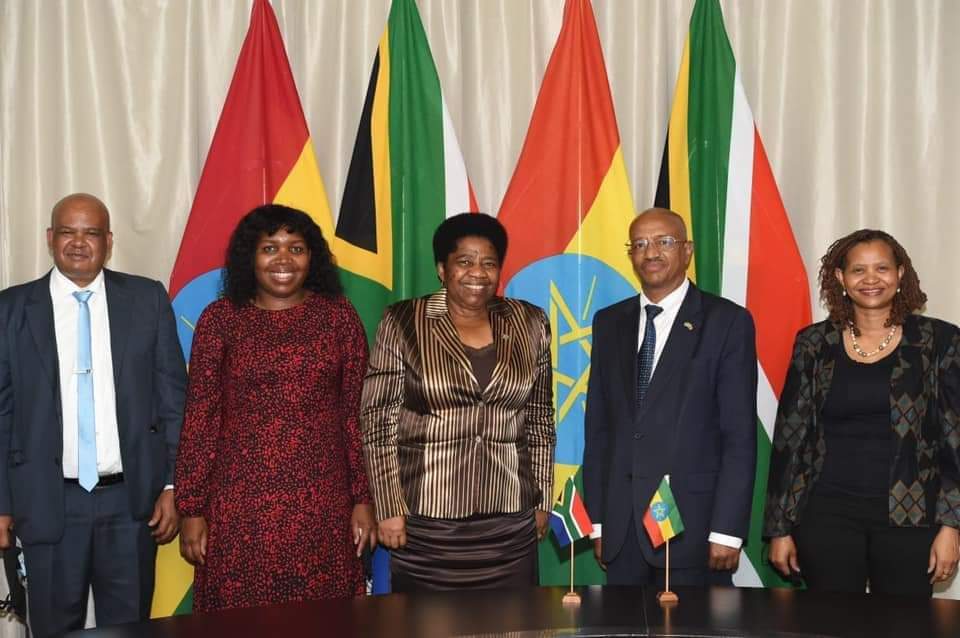
DEPUTY MINISTER MASHEGO-DLAMINI BIDS FAREWELL TO THE ETHIOPIAN AMBASSADOR TO SOUTH AFRICA, H.E MR SHIFERAW TEKLEMARIAM MENBACHI, AT OR TAMBO BUILDING, PRETORIA. 

07/10/2021

South Africa and the Federal Democratic Republic of Ethiopia (FDRE) established formal diplomatic relations in 1994.

Consequently the SA Embassy was established in Addis Ababa in August 1994, with SA’s first Ambassador Extraordinary & Plenipotentiary to Ethiopia (and also accredited to the OAU), Amb. WAW Nhlapo, presenting Credentials to the Ethiopian President on 8 February 1995.

Best wishes to Amb Menbachi, as he embarks on a new journey. Many thanks for the work done in bolstering bilateral relations between South Africa 🇿🇦 and Ethiopia 🇪🇹.

#SAEthiopiaRelations

#EthiopiaInSA