KEYNOTE ADDRESS BY PRESIDENT CYRIL RAMAPHOSA AT THE WTO PUBLIC FORUM

28 September 2021

Your Excellencies,

Heads of International Organisations,

Distinguished participants,

Ladies and gentlemen,

I wish to thank Dr Ngozi Okonjo-Iweala for the honour of addressing this important event.

The WTO Public Forum is a unique opportunity to hear a broad range of global voices on trade, development and human progress.

This is a particularly valuable platform as the global community confronts the COVID-19 pandemic and the devastating effect it has had on lives, on health, on livelihoods and on society.

As we consider the WTO response to the pandemic, I am reminded of President Nelson Mandela’s address on the occasion of the 50th Anniversary of the General Agreement on Tariffs and Trade.

In his remarks, President Mandela called for a WTO that recognises the frustrations of ordinary people.

He emphasised the importance of trade rules and that they should be fair.

He said that special consideration must be given to developing economies, and that the WTO should contribute to changing, rather than defending, the existing patterns of production.

Importantly, he called for WTO members to forge a partnership for development through trade and investment.

President Mandela’s message is as relevant today as it was at that time.

The world is at this moment experiencing the debilitating effects of inequality in the patterns of global production.

While human ingenuity has produced several effective and safe COVID-19 vaccines, human inertia has severely limited access to these vaccines.

Our inability to act on the call by President Mandela to change patterns of production has cost the world millions of lives and has undoubtedly extended the duration of the pandemic.

It is said that less than 2 per cent of adults are fully vaccinated in most low-income countries, compared to almost 60 per cent in high-income countries.

This gross inequality is both unjust and counterproductive.

The longer it takes to vaccinate the world’s population, the greater the loss of life, the likelier the emergence of new variants, and the longer it will take to achieve sufficient population immunity.

The rapid and equitable roll-out of life-saving medical products is the best response to the virus and the best stimulus plan for a strong, sustained and even economic recovery.

The WTO has a central role in addressing trade and intellectual property related barriers to boost and diversify production of vaccines, diagnostics and therapeutics.

Passing a time-bound, targeted TRIPS Waiver is urgent if we are to save millions of lives.

This is a proportionate response to the exceptional circumstances presented by the COVID-19 pandemic.

Unequal access to vaccines presents a huge risk to a sustained global recovery.

The Economist Intelligence Unit estimates that vaccine inequality will come at a cost of some $2.3 trillion to global GDP between 2022 and 2025.

We therefore need to reaffirm the principle of global solidarity and the role of open, inclusive multilateralism.

While there has been some recovery in international trade since the start of the pandemic, it has been uneven.

A relatively positive short-term outlook for global trade is marred by regional disparities, continued weakness in services trade, and lagging vaccination timetables, particularly in poor countries.

According to the World Bank, global growth is expected to accelerate to 5.6 per cent this year with only two major economies accounting for a quarter of this growth.

However, in low-income economies, where vaccination has been slow, growth projections have been revised lower to 2.9 per cent.

As a consequence, the UN 2030 Sustainable Development Agenda has been set back by many years.

We are not, as yet, building back better, nor are we building back together.

With the lives and livelihoods of billions of people across the world at risk, the opportunity for a coordinated response must not be squandered.

As we move towards the 12th Ministerial Conference, we must urgently take bold steps to expand and diversify locations of production to enable all countries to obtain life-saving medical products and technologies.

The aspirations of the Marrakesh Agreement should be at the centre of our actions towards a post COVID-19 economic recovery.

We need to recognise that trade is not an end in itself but a means of raising standards of living, creating employment and improving people’s lives.

This means that we must ensure that developing economies, and especially the least developed among them, secure a share in the growth in international trade commensurate with the needs of their economic development.

Now more than ever, we need a multilateral trading system that promotes inclusive economic growth and development, with the World Trade Organization at its core.

The reform of trade-distorting domestic support in agriculture is a long standing agenda that has become more urgent in the context of COVID-19.

UN Agencies report that global farm subsidies have reached $540 billion a year.

Without reform, the level of agriculture subsidies could rise to $2 trillion a year by 2030.

These subsidies affect the competitiveness of agriculture especially in developing economies, with damaging consequences for food security, livelihoods and local production.

We must address the asymmetries in existing WTO Agreements that perpetuate trade patterns which confine developing economies to the lower end of global value chains.

We need trade rules that create more opportunities for structural transformation and industrialisation in developing economies.

This is particularly important for African countries, which need to increase their rates of industrialisation.

The WTO and the global community will need to consider special measures to boost and support these efforts.

We must build an inclusive digital economy in which approaches to technology transfer are mutually-beneficial and the benefits of digital industrialisation and management of data flows are equally felt across the world.

Importantly, measures taken to address climate change must be effective and show a strong ambition.

They must enable developing countries to address the industrialisation gap and must conform to our WTO commitments. We need to ensure that they are not disguised forms of protection.

Our success in combating climate change will requires that concessional funding is available to support a just transition in developing economies that are still dealing with the challenges of job creation, poverty alleviation and inclusive growth.

We are aware that the support being provided to firms, income and employment at this time will elevate sovereign and corporate debt levels.

We need to work together to ensure that this debt does not threaten a sustainable, broad-based economic recovery.

The WTO’s trade and debt work and collaboration with the IMF and the World Bank is critical.

In this work – and indeed in all areas of trade – we must recognise that the WTO is made up of countries at different levels of economic development.

We need an effective multilateral trading system that cultivates an appropriate balance between national development strategies and multilateral cooperation.

We believe that the WTO is capable of finding negotiated solutions that are balanced and address the interests of all.

Such agreement on issues like the TRIPS waiver is both possible and necessary if the WTO is to live up to the expectations of the ordinary people of which President Mandela spoke.

The current global pandemic has presented the world with one of its greatest health, social and economic challenges in more than a century.

Through collaboration, through unity, through solidarity and mutual respect, through bodies like the World Trade Organization, let us rise to these challenges.

And let us build a fairer, more prosperous and more resilient world.

I thank you.

REMARKS BY PRESIDENT OF THE REPUBLIC OF SOUTH AFRICA, H.E. CYRIL RAMAPHOSA AT THE GLOBAL COVID-19 SUMMIT ON ENDING THE PANDEMIC AND BUILDING BACK BETTER HEALTH SECURITY TO PREPARE FOR THE NEXT

22 September 2021

President Joe Biden,

Vice-President Kamala Harris,

Excellencies,

Colleagues,

President Biden allow me to thank you for convening this important summit Covid 19. This coronavirus pandemic has not only led to the untimely death of millions of people around the world but has also destroyed a lot of livelihoods.

I applaud you President Biden for the generosity that has been demonstrated by the United States under your leadership by donating millions of vaccines to several countries around the world to help us cope with this pandemic. South Africa has been very grateful beneficiary of your generosity for which we thank you.

This summit marks an important milestone in our response to the Covid nineteen pandemic to account and vaccinate the world.

South Africa is encouraged that the goals and targets for ending the pandemic are broadly aligned with the key components of the Access to COVID-19 Tools Accelerator.

However, we must take current realities into account.

We have committed to vaccinating at least 70% of the world’s population by next year, but we are now at the end of September and have not reached the 10 per cent target we set ourselves in May.

The gulf is widening between better-resourced nations who are buying up and even hoarding vaccines and developing countries who are struggling to have access to vaccines. The pandemic has revealed the full extent of the vaccine gap between developed and developing economies and how that gap can severely undermine global health security.

Of the around 6 billion vaccine doses administered worldwide, only 2 per cent of these have been administered in Africa, a continent of more than 1,2 billion people. This is unjust and immoral.

Whilst we welcome the donations and sharing of vaccines to developing countries. We however reiterate our proposal that developing countries should be enabled to manufacture their own vaccines as well as to procure them directly. South Africa and India have proposed that the WTO should approve the proposal we have made for the waiver of the TRIPS provision.

With a view to ensuring that African countries would have better access to vaccines all African Union member states signed an agreement through The Africa Vaccine Acquisition Task Team to gain access to 220 million doses of the Johnson and Johnson vaccine.

South Africa will also host the WHO’s first COVID-19 mRNA vaccine technology transfer hub to serve the continent. Other African countries are also building capacity for manufacturing, supported by Partnership for Vaccine Manufacturing in Africa.

This Summit must come up with a sustainable plan on how developing countries will be supported. Not only to meet targets around vaccination, oxygen, diagnostics, personal protective equipment but also for manufacturing.

We must close the financing and supply gap for COVAX, AVATT and other mechanisms.

The greatest lesson we have learned from this pandemic is that fortune favours the prepared.

We support the establishment of a global health Financial Intermediary Fund for pandemic preparedness, as well as a Global Health Threats Council.

Cooperation, collective action and above all consensus, is our greatest strength in the current crisis, and will continue to be so in the future.

I thank you.

ADDRESS BY PRESIDENT CYRIL RAMAPHOSA ON THE OCCASION OF THE 20th ANNIVERSARY OF THE DURBAN DECLARATION DURING THE 76TH UNITED NATIONS GENERAL ASSEMBLY

22 September 2021 

President of the General Assembly, Mr Abdulla Shahid,

Secretary-General of the United Nations, Mr António Guterres,

United Nations High Commissioner for Human Rights, Ms. Michelle Bachelet, Excellencies,

Ladies and Gentlemen,

It is 20 years since the world adopted the Durban Declaration and Programme of Action.

And it is 25 years since the people of South Africa adopted a democratic Constitution.

In that Constitution, we affirmed that as South Africans we are called upon to build a society based on social justice and fundamental human rights, with a view of correcting the injustices of our past.

These words ring true for all the injustices that have been committed against many peoples around the world.

Slavery was one of the darkest periods in the history of humankind and a crime of unparalleled barbarity.

Its legacy persists in the Americas, the Caribbean, Europe, the Middle East, and in Africa itself.

Millions of the descendants of Africans who were sold into slavery remain trapped in lives of underdevelopment, disadvantage, discrimination and poverty.

South Africa calls on the United Nations to put the issue of reparations for victims of the slave trade on its agenda.

We support the adoption of special measures, including affirmative action programmes and targeted financial assistance, as restitution to communities whose ancestors were sold into slavery.

We further support all measures being undertaken to address the historic and contemporary discrimination against people of African descent.

This includes increasing representation of people of African descent in global institutions and in positions of leadership.

As we strive to correct the wrongs of the past, we must combat the racism, sexism and national chauvinism of the present.

Racism directed at ethnic minorities, migrants, refugees, the LGBTQI+ community and other marginalised groups has led to the denial of opportunity, to institutionalised discrimination, and to violence.

Twenty years ago at the World Conference against Racism, we committed to an anti- discrimination agenda that would bring new hope and change to the lives of millions.

Just as we stand united to combat the COVID-19 pandemic, must recommit ourselves to implement the Durban Declaration and Platform for Action.

We must pursue this objective with energy and goodwill.

Ending racism is a fight in which each of us has a stake.

Let us all allow humanism to be our guide and solidarity be our strongest force.

We are called upon by history to redouble our efforts to build a world free of racism, to right the wrongs of the past and to restore the human dignity of all.

I thank you.
MINISTER PANDOR ARRIVES IN NEW YORK FOR THE UN GENERAL ASSEMBLY

20 September 2021

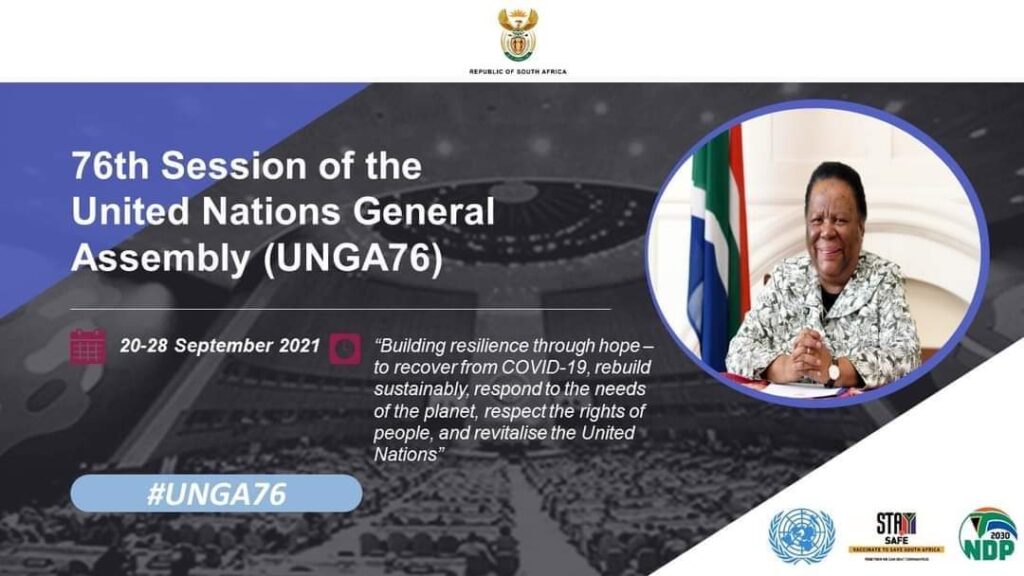
The Minister of International Relations and Cooperation, Dr Naledi Pandor, has today, Monday, 20 September 2021, arrived in New York, where she will be participating in the 76th Session of the United Nations General Assembly (UNGA76).

This year’s UN General Assembly is scheduled for 20-28 September 2021 under the theme: “Building resilience through hope – to recover from COVID-19, rebuild sustainably, respond to the needs of the planet, respect the rights of people, and revitalise the United Nations”. The theme was announced by the President of the General Assembly (PGA), Mr Abdulla Shahid of the Maldives.

Due to the ongoing COVID-19 pandemic, the General Debate and High-Level Meetings of the 76th Session of the UN General Assembly (UNGA76), will be held in a hybrid in-person and virtual format.

President Ramaphosa will deliver a pre-recorded video statement at the General Debate on 23 September 2021. During the General Debate, which will commence on 21 September 2021, heads of the delegation are expected to state the positions of their governments on topical issues that the United Nations is seized with. These issues pertain to the three pillars of the work of the UN system, namely, peace and security, human rights, and development. The General Debate will also provide member states with an opportunity to raise matters relating to priorities and concerns that are of a national, regional, and global nature.

President Ramaphosa will also deliver a pre-recorded video statement at the High-Level Meeting on the 20th anniversary of the World Conference against Racism and the adoption of the Durban Declaration and Programme of Action (DDPA) on 22 September 2021 and Minister Pandor will participate in the round-table discussions in person.

The High-Level Meeting to commemorate the DDPA will take place under the theme: “Reparations, racial justice and equality for people of African descent.” South Africa and Portugal have co-facilitated and lead consultations on the political declaration and modalities of the high-level meeting. As an outcome of the High-Level Meeting, member states will adopt a political declaration aimed at mobilising political will at the national, regional, and international levels for the full and effective implementation of the Durban Declaration and Programme of Action and its follow-up processes.

The overarching issues that are expected to be dominant and of relevance to South Africa during UNGA76 include The recovery from the COVID-19 pandemic; discussions on the UN Secretary-General’s report entitled “Our Common Agenda” following the 75th anniversary of the United Nations; reform of the United Nations; peace and security matters; the implementation of the 2030 Agenda on the Sustainable Development Goals (SDGs); and climate change and the upcoming Conference on Climate Change (COP26) to be held in Glasgow in November 2021.

Minister Pandor will also attend several high-level meetings and side events taking place on the margins of UNGA. Amongst other events, the Minister is expected to co-chair the Comprehensive Nuclear-Test-Ban Treaty Article XIV Conference with her Italian counterpart on 23 September 2021 and will deliver a pre-recorded statement at the High-Level Meeting on the International Day for the Total Elimination of Nuclear Weapons on 28 September 2021.

The Minister is also expected to take part in bilateral meetings with counterparts, as well as with representatives of the United Nations system.

Minister Pandor stated that: “Attending UNGA76 is of priority to South Africa. We have consistently called for the strengthening of multilateralism as the only system that would allow the world to collaborate and deliver fair outcomes for all states in the wake of the pandemic. A socio-economic response is required with additional assistance to developing countries.”

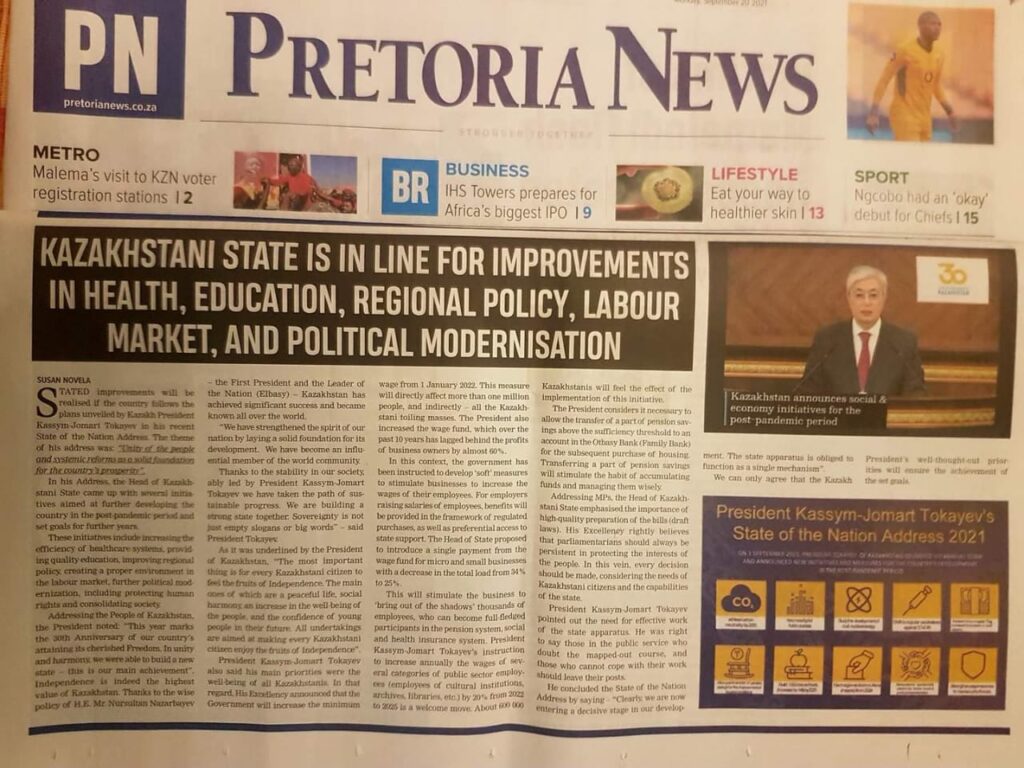
PRETORIA NEWS 20 SEPTEMBER 2021

KAZAKHSTANI STATE IN LINE FOR IMPROVEMENTS ON HEALTH, EDUCATION, REGIONAL POLICY, LABOUR MARKET, AND POLITICAL MODERNISATION

By: Susan Novela

WEBINAR ON THE EXPO 2020 DUBAI

1 OCT 2021 – 31 MARCH 2022

Expo 2020 Dubai, ‘Connecting Minds and Creating the Future’ through sustainability, mobility and opportunity”

Expo a tool for economic, culture and social improvement, collaborating of the most powerful countries in the world that act together for a global growth and aiming at activating the achievement of the goals of sustainable development at the level of countries, communities, families through .

Ambassador Mahash Alhameli of UAE to South Africa says “Year 2021 Marks 50th Years of UAE’s golden jubilee”

WHAT ARE THE COVID-19 RULES AT EXPO 2020 DUBAI? DO VISITORS NEED TO BE VACCINATED TO ENTER EXPO 2020 DUBAI?

Visitors to Expo 2020 Dubai will need to show evidence of a Covid-19 vaccination or a negative PCR test taken within the previous 72 hours.

With less than a month to go before Expo 2020 Dubai opens to the public, stringent health precautions are being taken to ensure the site is safe for visitors despite the Covid-19 pandemic.

Millions visitors are expected during the Expo, which stretches over 182 days with cultural shows and conferences taking place daily,  org anisers have “relentlessly worked on sanitary and security measures” to make sure a visit to the World Expo is enjoyable and safe.

FAREWELL RECEPTION FOR MS ZHULDYZ AKISHEVA, UNODC REGIONAL REPRESENTATIVE HOSTED BY MS NARDOS BEKELE-THOMAS THE UN RESIDENT COORDINATOR IN SOUTH AFRICA

17 September 2021

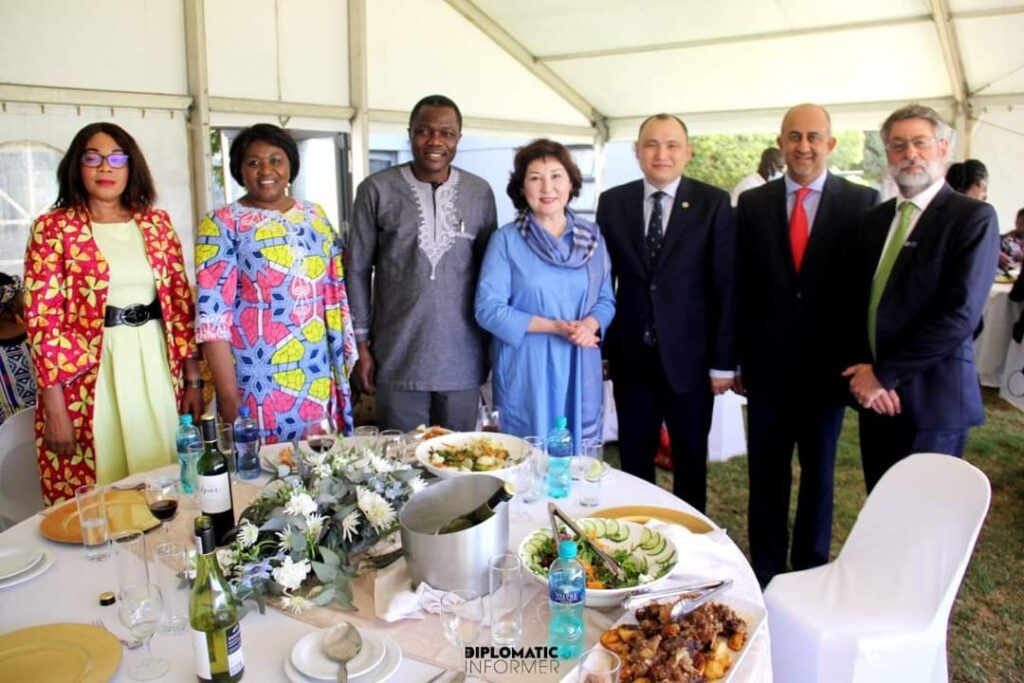
Ms Nardos Bekele-Thomas the UN Resident Coordinator in South Africa hosted a Farewell Reception for Ms Zhuldyz Akisheva, Regional Representative of United Nations Office on Drugs and Crime (UNODC). UNODC is a global leader in the fight against illicit drugs and transnational organized crime, terrorism and corruption.

Ms Zhuldyz Akisheva  is a Kazakhstan Citizen, a seasoned Diplomat and A Diplomat Par excellence, prior to her role in South Africa and the SADC Region, she worked as the Country Manager for UNODC Country Office in Viet Nam (2010- 2015), Head of the UNODC Programme Office in Kyrgyzstan (2008-2010), Deputy Regional Representative at the UNODC Regional Office for Central Asia (2004 – 2008) and has more than 17 years of work experience with UNODC both at HQ and field

The Farewell Reception was attended by Hon.  Lindiwe Zulu, Minister of Social Development , Hon. John Jeffery, Deputy Minister of Justice, Head Representatives of the UN Agencies in South Africa, Representative of Department of International Relations and Cooperation, Diplomatic Corps, His Excellency Ambassador Kanat Tumysh of Kazakhstan, Mr Bernard Rey, Head of Development Cooperation, European Union delegation in South Africa, Representatives of the Department of Justice, Representatives of  National Prosecution Authority,  Hawks and Civil Society.

Ms Zhuldyz Akisheva,  a Kazakhstan Citizen, A seasoned Diplomat and A Diplomat Par excellence, You exemplified women leadership excellence in Your role in South Africa and the Region.

The Diplomatic Informer Magazine SA, wishes Ms Zhuldyz Akisheva, UNODC Regional Representative success in all her future endeavors.

Images: The Diplomatic Informer Magazine SA

 Calvin Modirapula

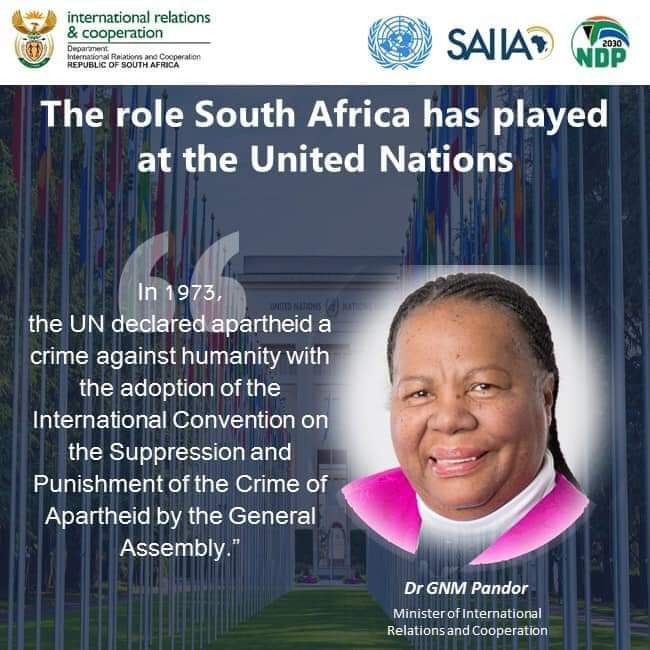
MINISTER NALEDI PANDOR ADDRESSED THE WEBINAR ON SOUTH AFRICA’ S ROLE AT THE UNITED NATIONS

17 September 2021

In her opening remarks Minister Pandor said for South Africa, the United Nations will always have special meaning. – “The centrality of the United Nations to South Africa’s foreign engagement is in part based on a strong belief in collective and equitable global governance, but also because of the organisation’s role in the fight against apartheid.”

Minister added that through the many decades leading up to 1994, the UN took many important steps that assisted in the international struggle against apartheid.

“The UN became the arena where the morality and legality of the system of Apartheid was questioned.”

Minister Pandor recalled that as early as June 1946, the issue of South Africa’s discrimination policies was proposed by India as an agenda item in the second session of the UN General Assembly. This was despite the fact that SA was one of the founding members of the UN.

South Africa’s foreign policy principles have always supported multilateralism and the promotion of global peace and security.

COVID-19 has reminded us why multilateralism is important.

Minister reiterated the need for international collaboration to defeat common challenges

“We have seen that as with these other contemporary challenges, no country acting alone can successfully deal with them”

The pandemic has set back progress on the achievement of the African Continent’s Agenda 2063 and the UN’s Sustainable Development Goals.

As the 76th Session of the UN General Assembly draws nearer, SA is looking forward to the the high level meeting to mark the 20th anniversary of the adoption of the Durban Declaration and Programme of Action (DDPA) at the World Conference against Racism, held in Durban, in 2001.

“The DDPA remains the international community’s blueprint for action to fight racism both historically and in the present.” – Minister Naledi Pandor

Furthermore, this event, co-facilitated by South Africa and Portugal, provides an opportunity to renew collective commitment to combatting racism, racial discrimination, xenophobia and related intolerance.

South Africa has been privileged to serve thrice in the UN Security Council as a non-permanent member and has actively promoted adherence to the mandated role of the UNSC.

Min. Pandor pointed out that South Africa has continually resisted attempts to convert the UN into a body that advances the interests of the more powerful permanent members. South Africa continues to place human rights and freedom at the forefront of its global agenda.

South Africa has consistently argued for reform of the UNSC.

Images: Dirco

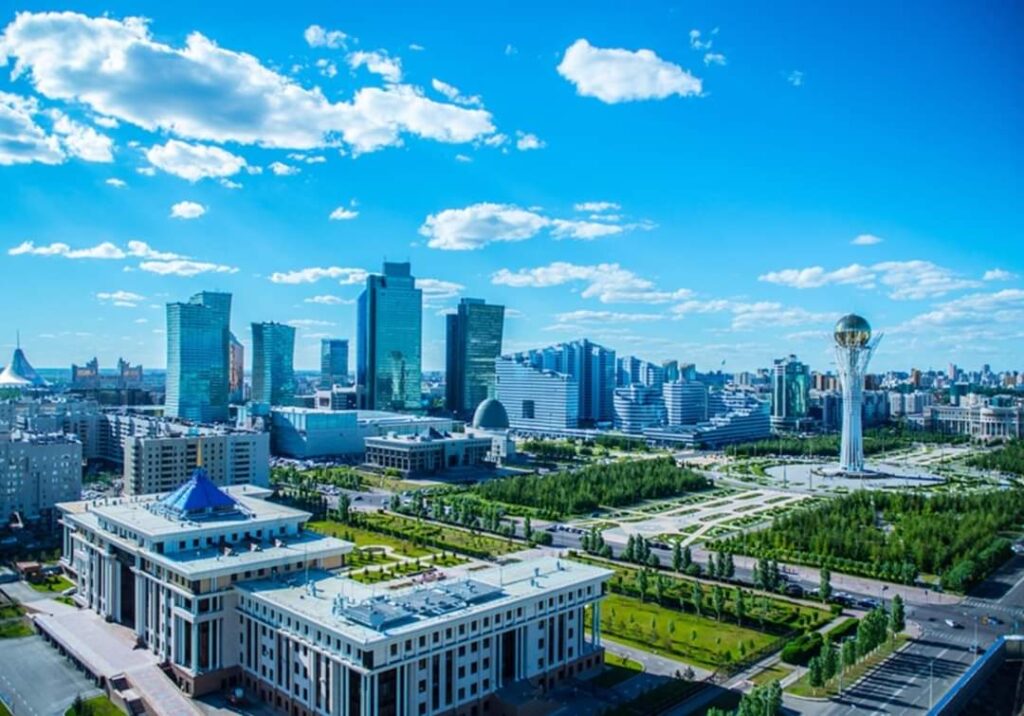
KAZAKH CAPITAL ATTRACTS NEARLY $1.2 BILLION IN SEVEN MONTHS

BY ASSEL SATUBALDINA

NUR-SULTAN, 10 SEPTEMBER 2021

NUR-SULTAN – The Kazakh capital Nur-Sultan has attracted over 504 billion tenge (US$1.2 billion) within seven months, nine percent more compared to the same period in 2020, said Nur-Sultan Akim (Mayor) Altai Kulginov.

“The attractiveness of our capital for investors is growing every year. Despite the pandemic, both last year and this year, we managed to increase the volume of investment. We direct private investments to construction works that are necessary for the city and its residents. Last year, we attracted a record number of investments to the city – more than 1 trillion tenge (US$2.3 billion),” Kulginov wrote on his Instagram.

He said attracting investments and supporting investors remains a priority. Astana Invest, a regional front office, is tasked with fulfilling these tasks. It has supported more than 150 projects in medicine, education, logistics and trade, industry, sports, electricity, which created more than 18,000 jobs.

“For example, this year a number of private educational institutions, the production of building materials, and equipment were all put into operation. As part of the Economy of Simple Things program, 40 projects worth 55 billion tenge (US$128.9 million) were supported, including the construction of schools, medical centers, and perinatal prevention centers,” added Kulginov.

The construction of three wholesale and distribution centers and two greenhouse complexes with a capacity for 10,000 tons of products per year is ongoing but scheduled to be completed in 2022-2023.

According to Astana Invest, investors can be entitled to different state support mechanisms. One of them is an investment contract that may offer preferences, such as exemption from customs duties, corporate income tax, and value-added tax on the import of raw materials, as well as a full-scale state grant.

Establishing an enterprise in a special economic zone will also grant preferential conditions, including zero percent corporate income tax, property tax, value-added tax (VAT) on import, customs duties, and land tax. There are currently the Astana-New City and Astana Technopolis special economic zones operating in the capital.

Image: The capital continues to receive the lion share of investments in the country. Photo credit: elbasy.kz